How AI reads Benjamin Franklin Plumbing
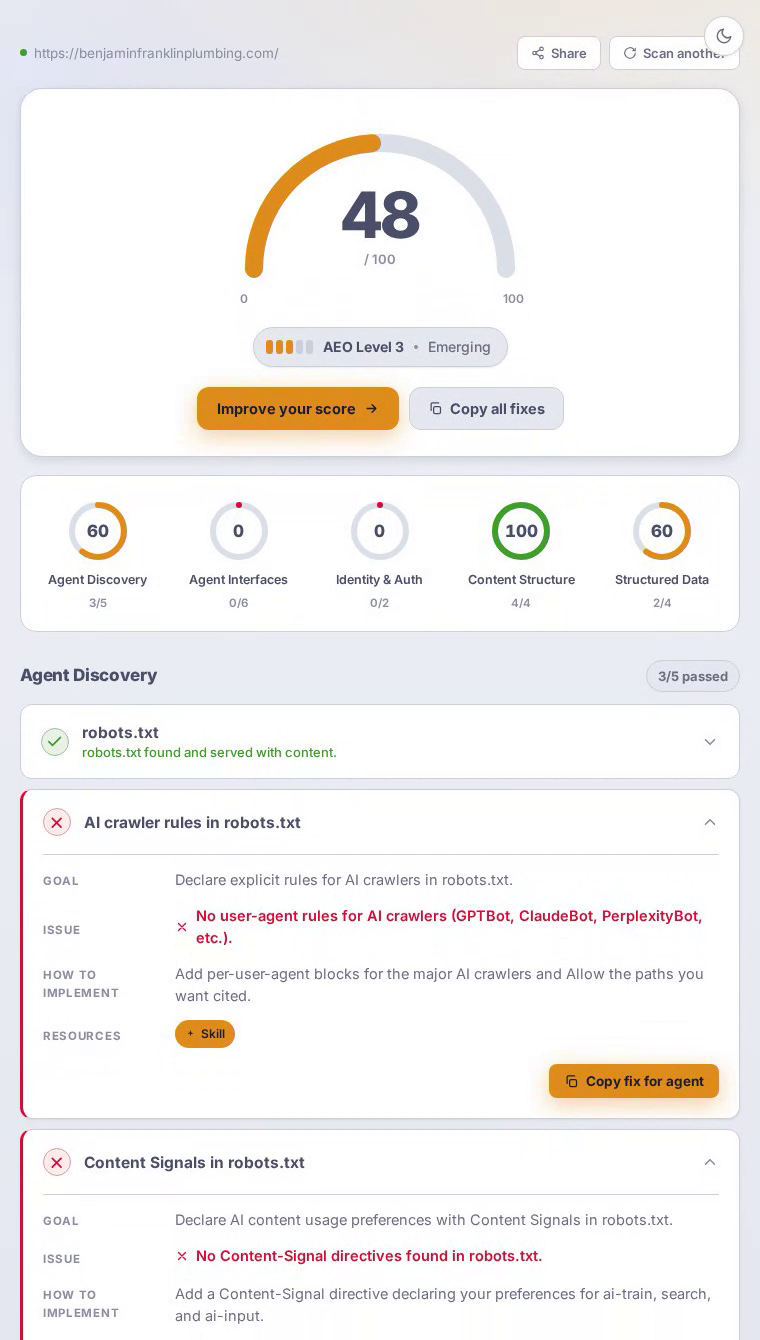
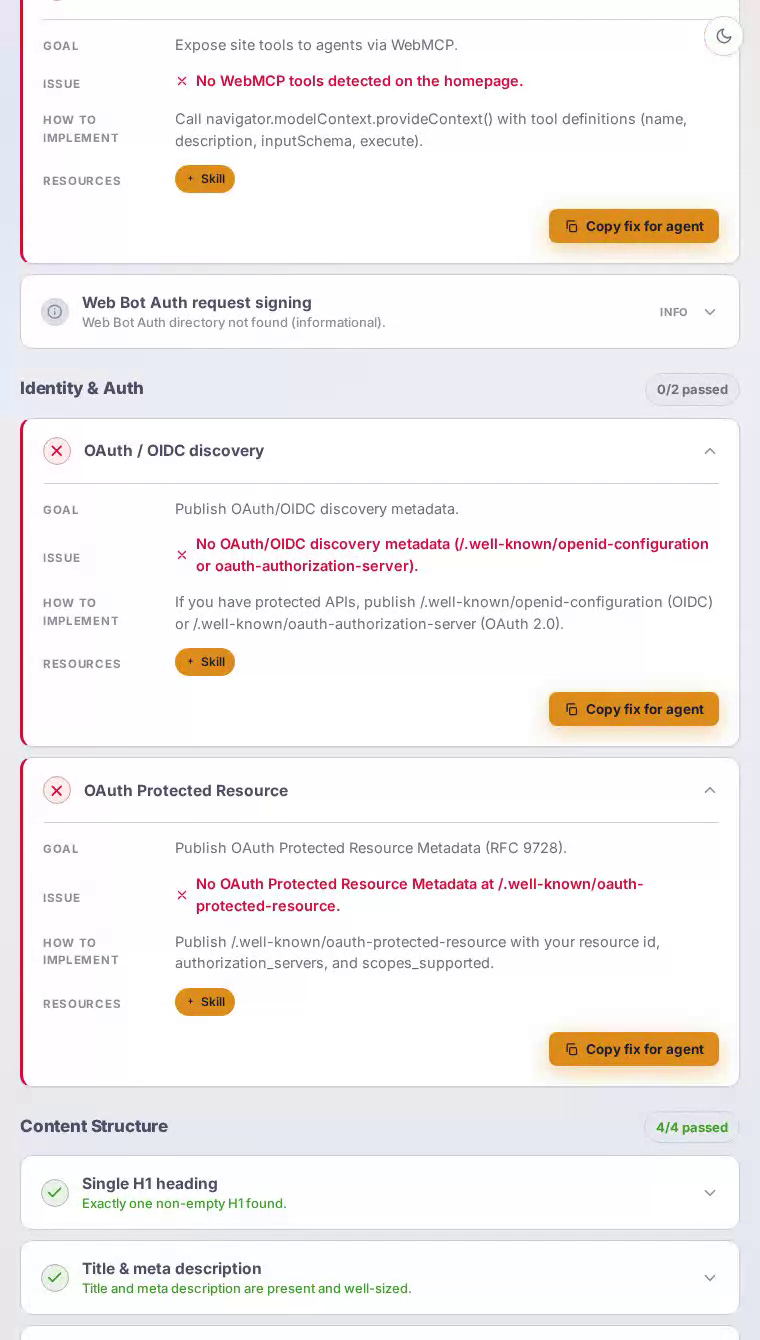
We scanned Benjamin Franklin Plumbing and found an AEO score of 48 out of 100. The site earns a perfect 100 for content structure, proving the HTML is AI-readable. However, it scores zero on agent interfaces and identity authentication, meaning AI agents can read the content but cannot interact with or verify the brand programmatically.
What AI sees
AI crawlers reach Benjamin Franklin Plumbing's homepage and find well-structured HTML, but encounter no machine-readable signals for agent interaction or brand identity.
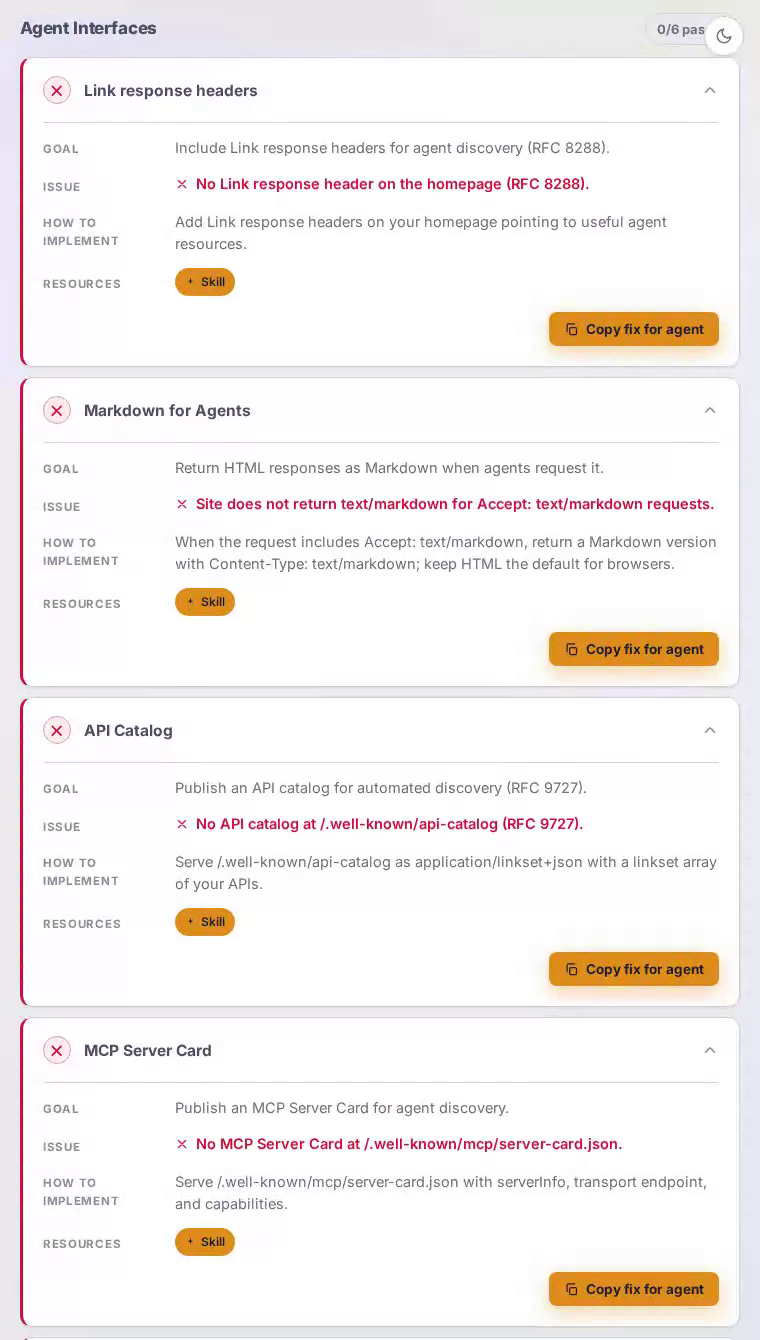
When an AI agent visits Benjamin Franklin Plumbing today, it finds a clean, well-organized homepage where service descriptions, location pages, and franchise information are legible to language models. Content structure scores a perfect 100, so the raw text is easy to parse. But the agent receives no robots.txt directives tailored for AI crawlers, so it falls back on default assumptions rather than explicit permissions. There are no Link response headers, no Markdown endpoint for cleaner content extraction, and no API catalog or MCP server card. The brand is findable — but not yet agent-optimized.
Where it loses points
Agent interfaces and identity authentication both score zero, leaving AI agents with no structured way to interact with or verify the Benjamin Franklin Plumbing brand.
How to fix it
Three targeted changes would immediately raise Benjamin Franklin Plumbing's AEO score and make it reliably citable in AI-generated answers.
AI Crawler Rules in robots.txt
Declare explicit per-agent rules so AI crawlers know exactly which paths they are allowed to access and index.
The robots.txt file contains no user-agent rules for GPTBot, ClaudeBot, PerplexityBot, or any other AI crawler.
Add individual User-agent blocks for each major AI crawler and pair them with Allow directives for the paths you want cited. This single change moves the site from invisible to explicitly indexed in AI training and retrieval pipelines.
Content Signals in robots.txt
Declare AI content usage preferences so crawlers and training pipelines respect your intent rather than deciding unilaterally.
No Content-Signal directives exist in robots.txt, leaving AI systems to make their own decisions about how to use the content.
Add a Content-Signal directive specifying preferences for ai-train, search, and ai-input alongside your AI crawler rules. It is a one-line addition that signals clear intent to every AI system reading the file.
Markdown for Agents
Return a clean Markdown version of the homepage when AI agents request it via the Accept header.
The site returns only HTML regardless of Accept header, forcing AI agents to parse full markup instead of receiving structured plain text.
Detect Accept: text/markdown in incoming requests and return a Markdown-formatted response with Content-Type: text/markdown. Keep HTML as the default for browsers — this is a progressive enhancement that costs one middleware function and measurably improves content extraction accuracy.
Common questions
What does Benjamin Franklin Plumbing's AEO score of 48 out of 100 mean?
Why does content structure score 100 if the overall AEO score is only 48?
Which single fix would have the biggest immediate impact on the AEO score?
Is your own site ready for AI?
Run the same five-category analysis on any URL. Free, no account needed to start.
Check your own website free