How AI reads GitHub
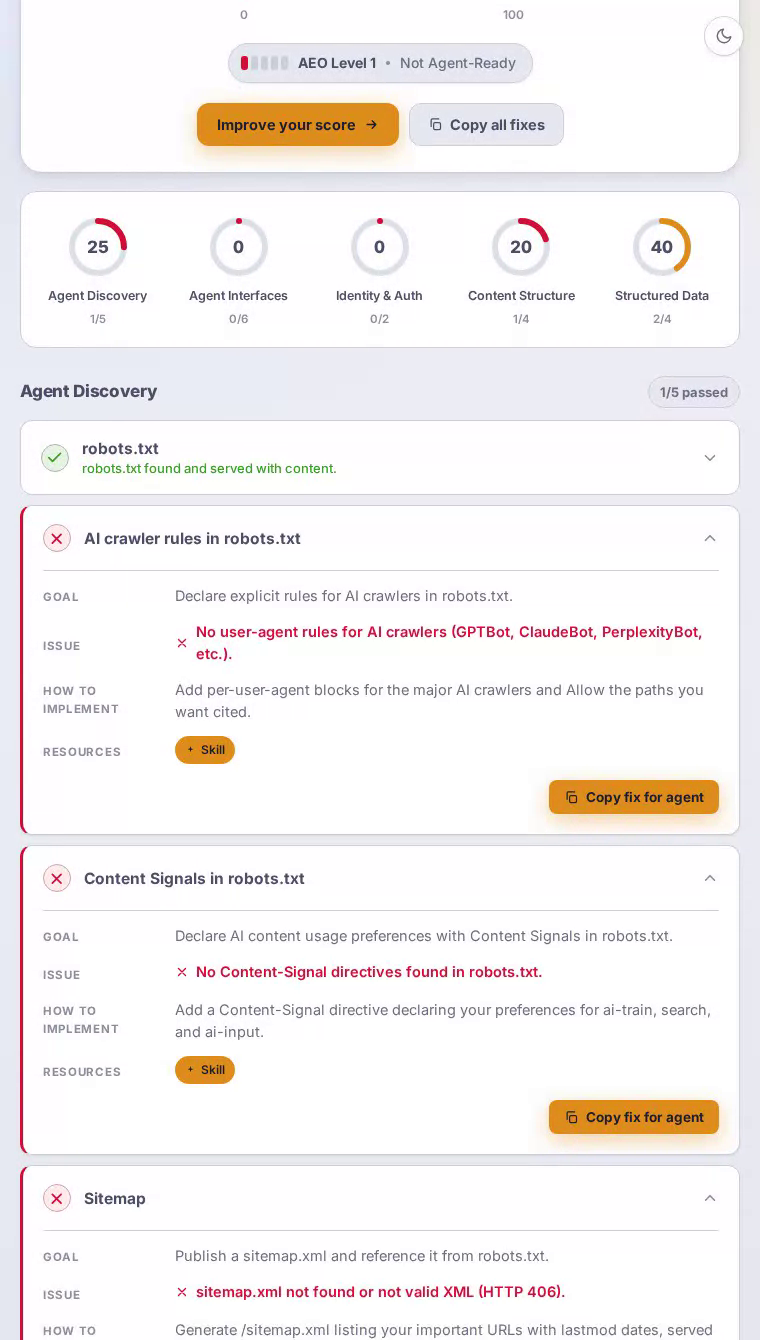
GitHub earned an AEO score of 18 out of 100, placing it at level 1. Despite being the world's largest code-hosting platform with a robust REST and GraphQL API, the site provides almost no structured signals for AI agents to discover, authenticate against, or interface with its capabilities.
What AI sees
An AI agent landing on GitHub today encounters a JavaScript-heavy interface built for human developers, not machine readers.
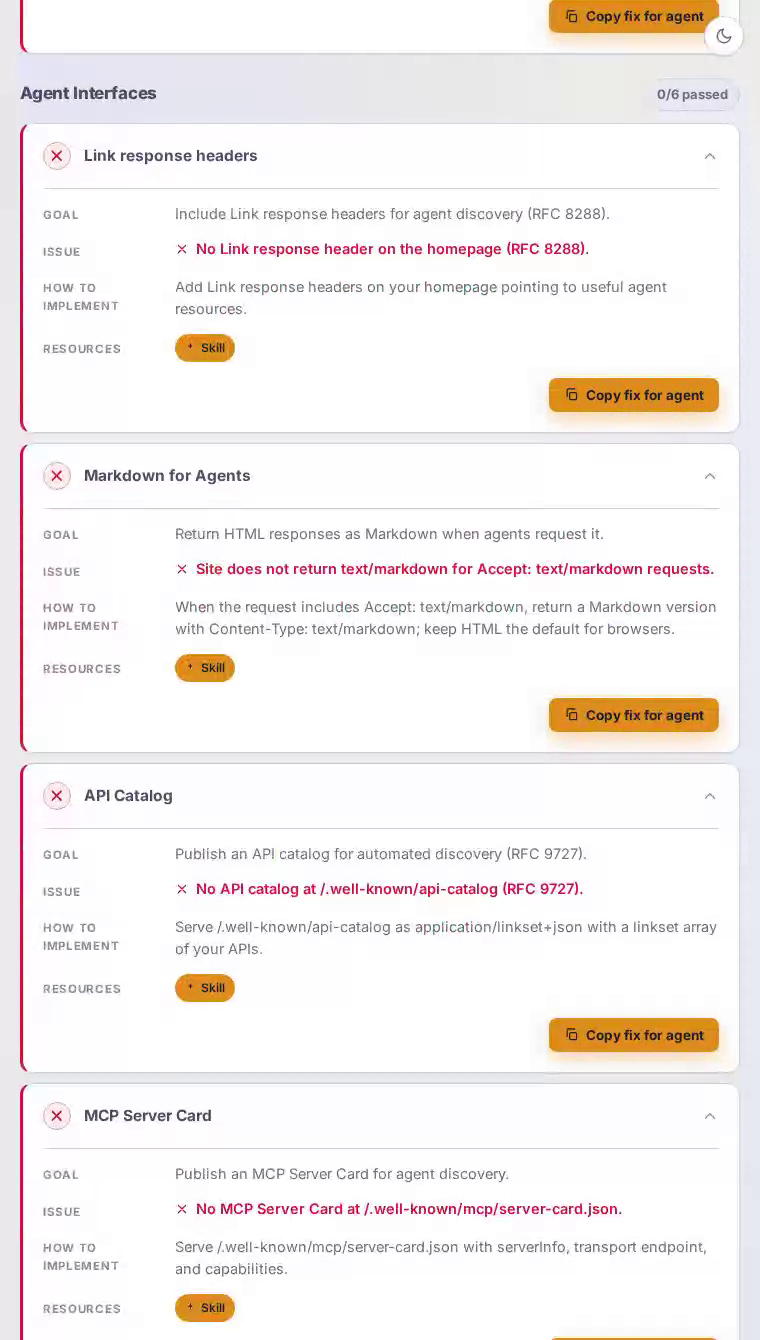
When an AI crawler hits GitHub's homepage, it receives a dense HTML document populated with repository cards, trending projects, and marketing copy — but none of it is wrapped in machine-readable structure that guides an agent toward the platform's actual value. There are no Link response headers pointing to API endpoints, no MCP Server Card advertising GitHub's considerable automation surface, and no Content-Signal directives signaling how the content may be used. Structured data coverage lands at a modest 40/100, but identity and agent-interface layers score zero. The platform millions of developers rely on for automation is ironically invisible to the very AI agents that could orchestrate it.
Where it loses points
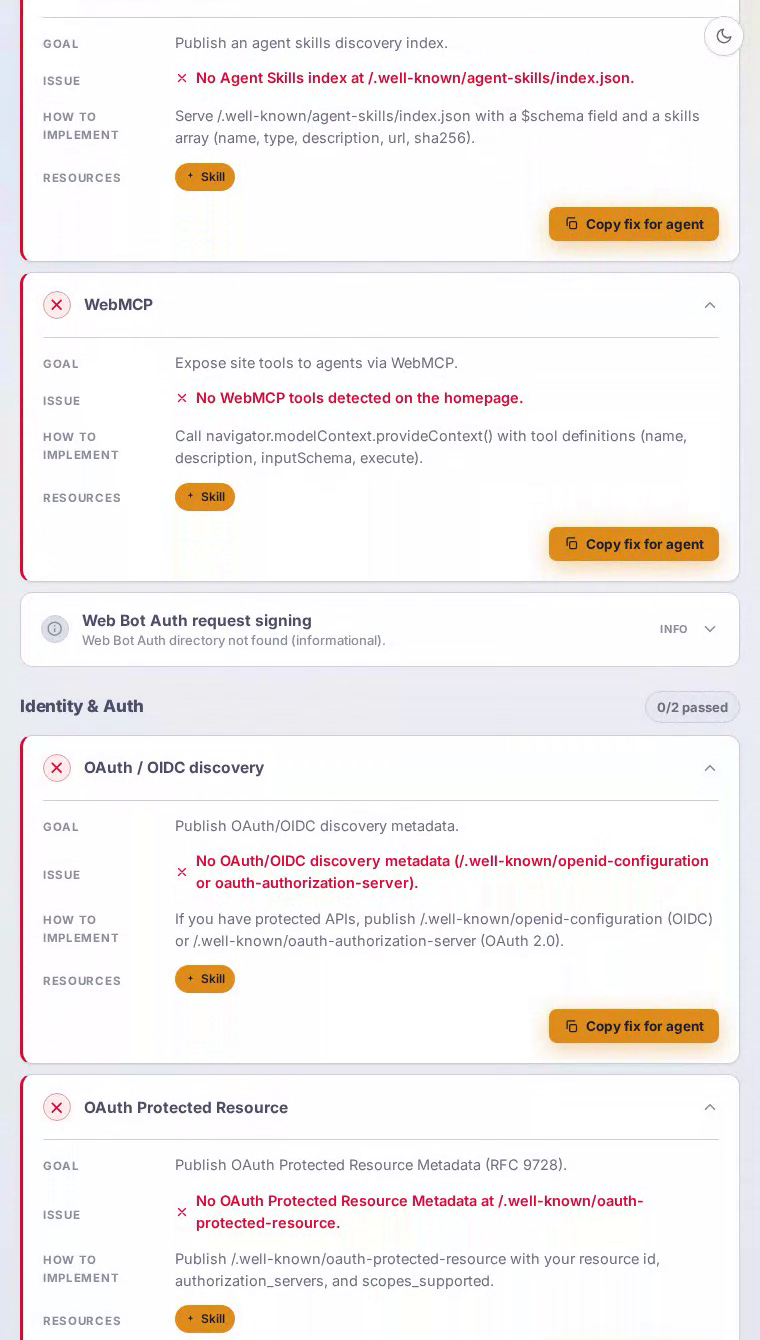
Agent interfaces and identity/auth are the deepest gaps, both scoring 0 out of 100.
How to fix it
Three targeted server-side additions would dramatically lift GitHub's AI readiness without touching a line of application code.
Publish an API Catalog
Expose GitHub's REST and GraphQL APIs through a machine-discoverable catalog at /.well-known/api-catalog following RFC 9727.
The scan found no /.well-known/api-catalog endpoint, leaving AI agents with no standardized way to locate or enumerate GitHub's API surface.
Serve /.well-known/api-catalog as application/linkset+json with linkset entries for the REST API, GraphQL endpoint, and webhook documentation. Any RFC 9727-aware agent can then instantly enumerate every automation surface GitHub offers without reading a single doc page.
Add an MCP Server Card
Publish a Model Context Protocol Server Card so AI agents can discover GitHub's tooling capabilities and transport endpoint.
No /.well-known/mcp/server-card.json exists, which directly drives the agent_interfaces score of 0.
Create /.well-known/mcp/server-card.json declaring serverInfo, the MCP transport endpoint, and capabilities such as repository search and pull-request management. This single file turns GitHub into a first-class tool for any MCP-compatible AI agent without API changes.
Declare AI Crawler Rules in robots.txt
Add explicit per-user-agent directives for major AI crawlers so they know exactly which paths are available for indexing and citation.
GitHub's robots.txt contains no rules for GPTBot, ClaudeBot, PerplexityBot, or similar crawlers, leaving agent_discovery stranded at 25/100.
Add individual User-agent blocks for each major AI crawler with Allow directives covering public repository content and README files. Pair each block with a Content-Signal directive declaring ai-train and ai-input preferences so AI systems act on explicit permission rather than guessing at intent.
Common questions
Why does GitHub score so low on AEO despite having a well-documented API?
Would adding AEO signals affect GitHub's existing SEO or human visitor experience?
What is the biggest opportunity if GitHub improves its AEO score?
Is your own site ready for AI?
Run the same five-category analysis on any URL. Free, no account needed to start.
Check your own website free