How AI reads Vercel
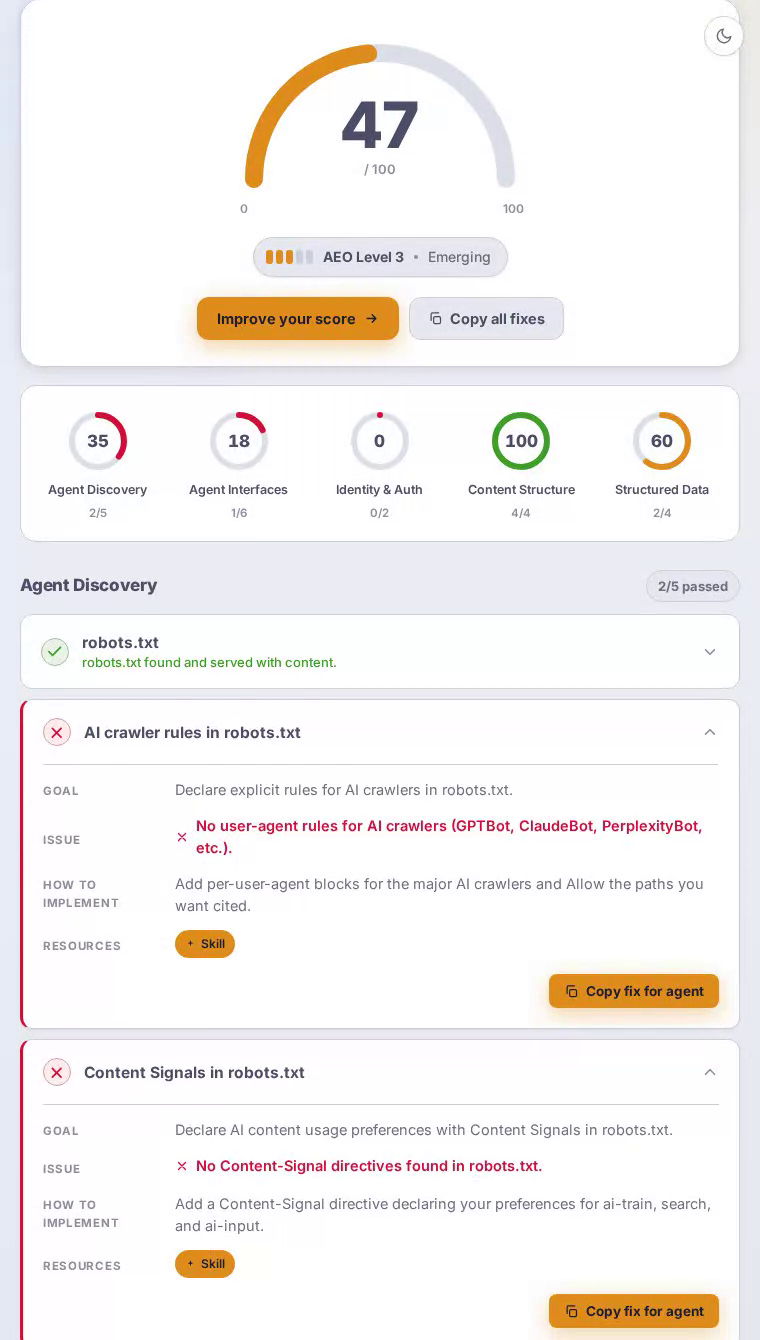
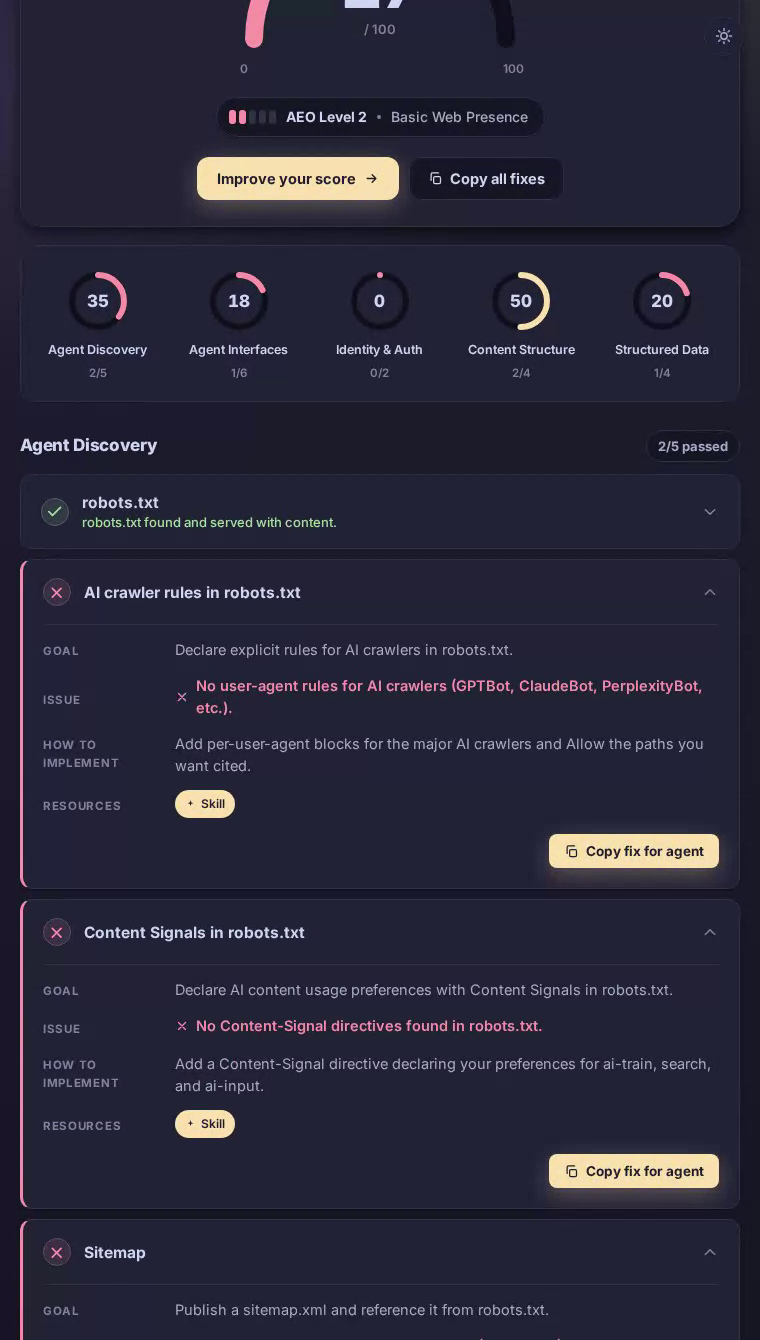
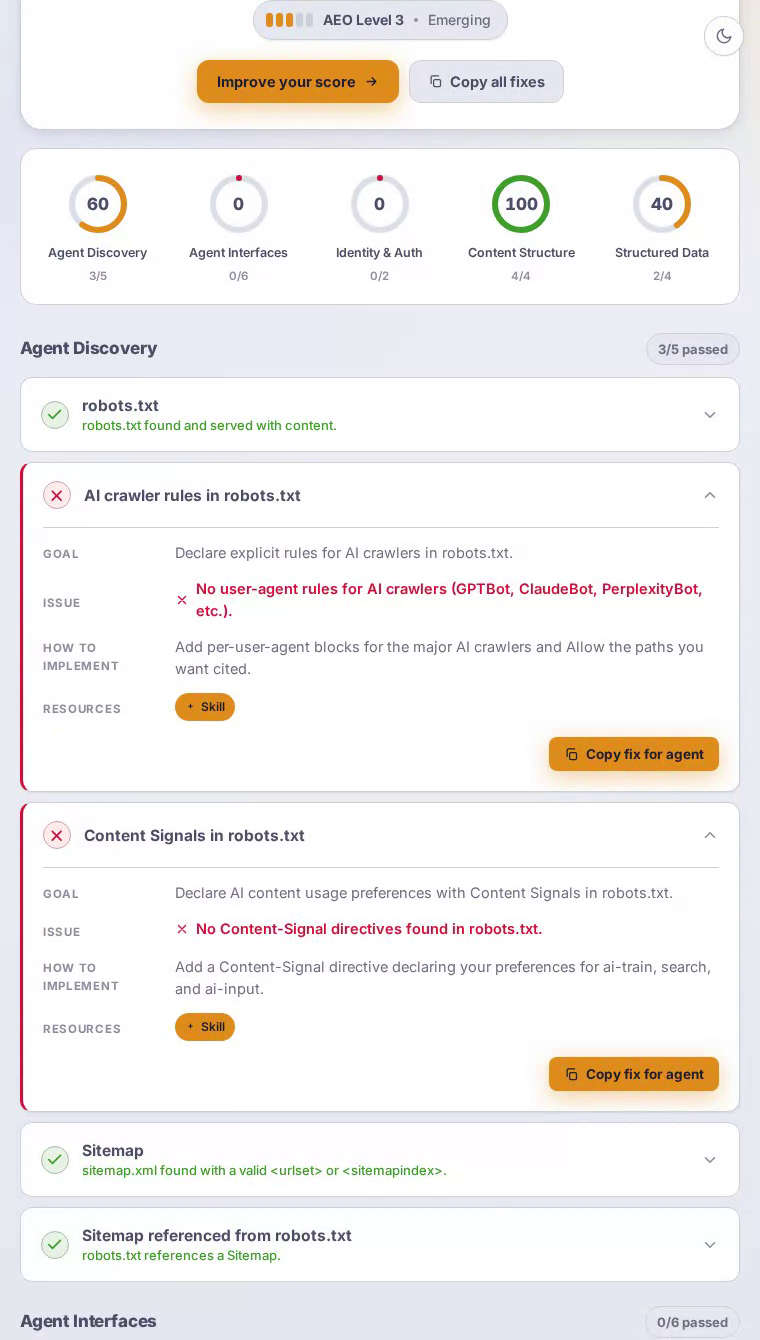
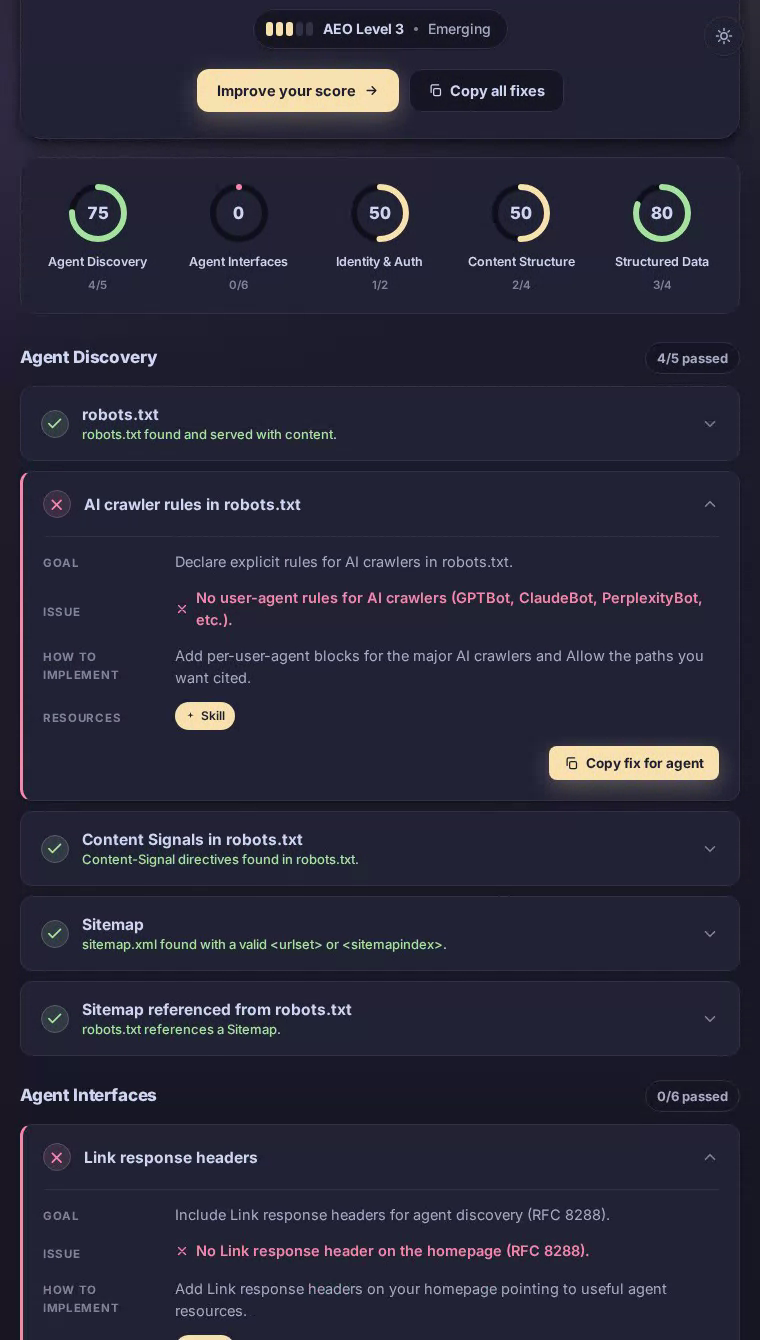
Vercel scores 50 out of 100 on AEO readiness. Strong structured data (80) and solid agent-discovery signals (75) are undercut by a complete absence of agent interfaces (0) — meaning AI assistants can read Vercel's content but cannot interact with its platform programmatically.
What AI sees
An AI crawler landing on Vercel's homepage today finds a well-structured page but almost no signals that a machine is welcome to do anything beyond read.
The homepage carries genuine schema markup — product and organization data that search and AI engines can parse with confidence, reflected in the 80 structured-data score. Vercel's technical documentation and feature descriptions are well-organized and indexable. What the agent does not find: a Markdown alternative when it sends Accept: text/markdown, RFC 8288 Link headers pointing to API or discovery resources, or any well-known endpoints advertising platform capabilities. For a company whose customers deploy AI-native applications daily, the gap between Vercel's content readability and its agent interactivity is striking.
Where it loses points
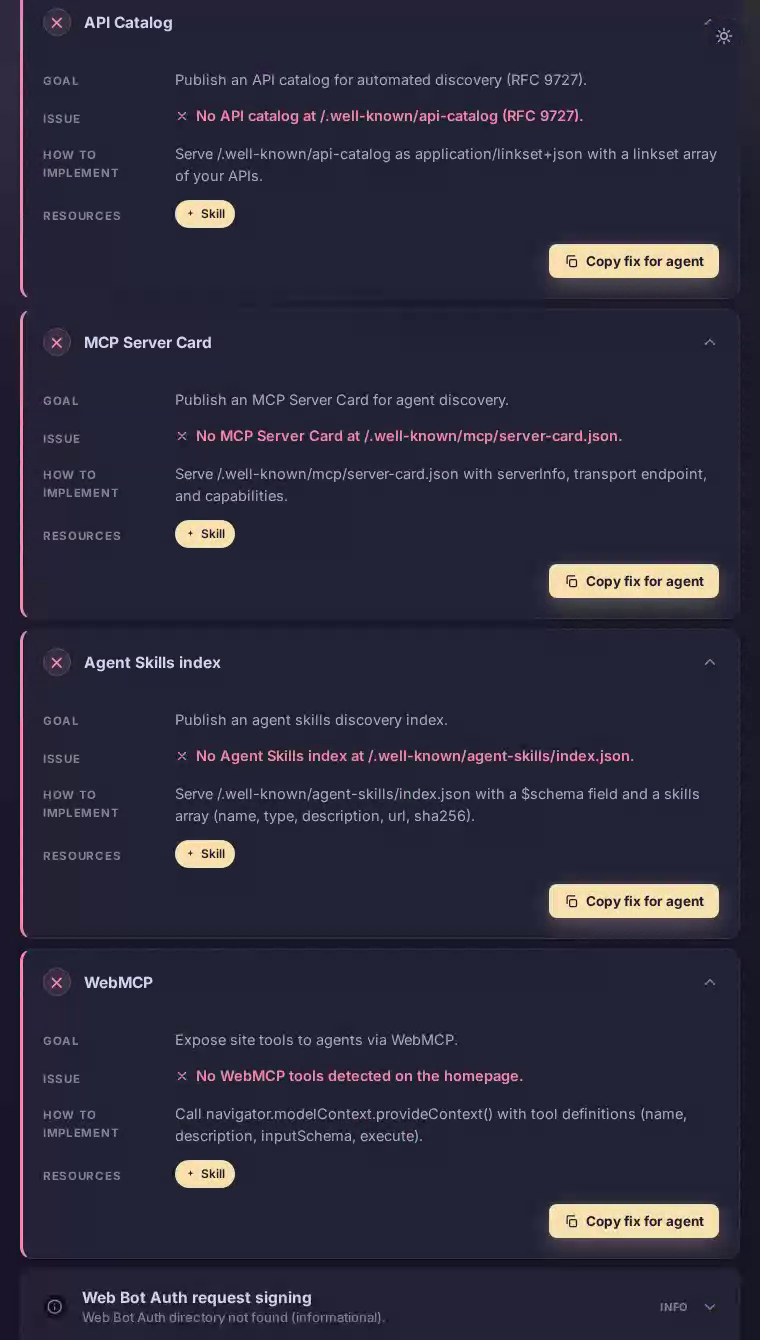
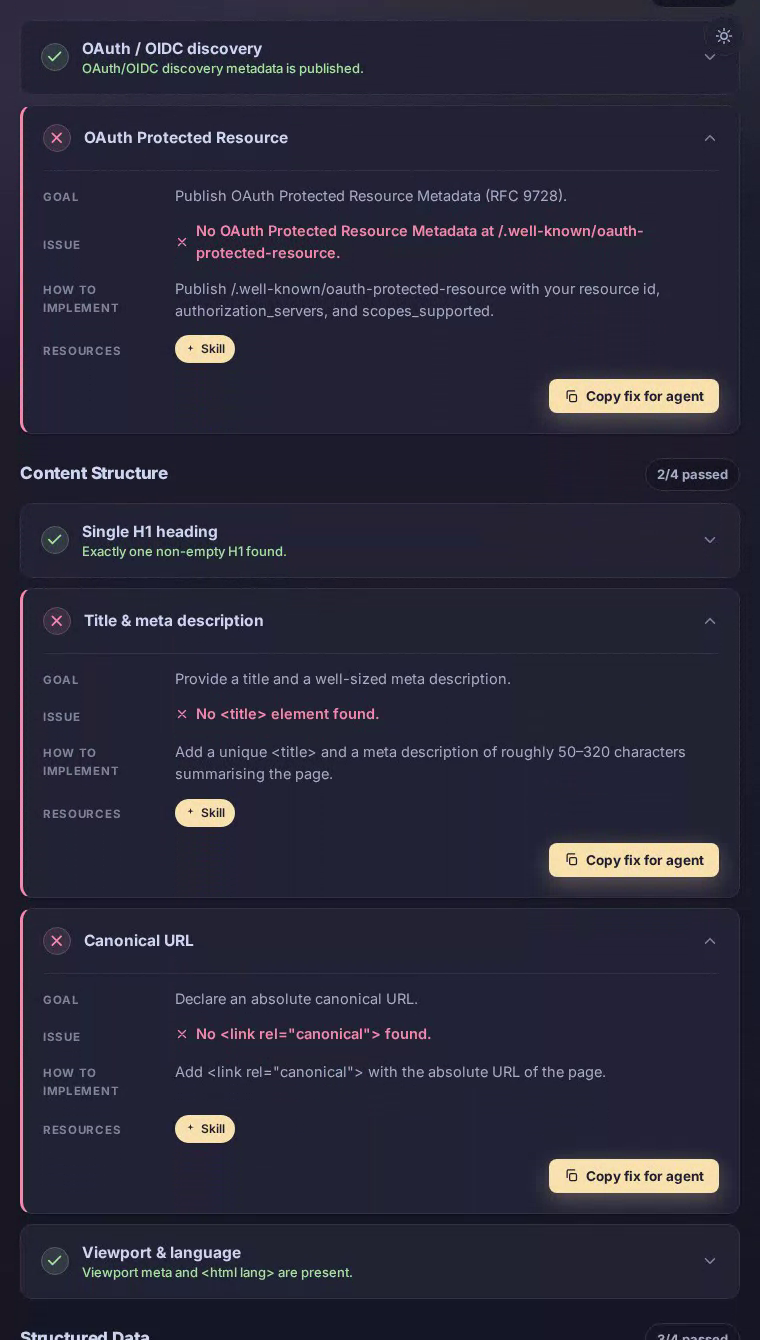
Agent interfaces score zero — not a single MCP server card, API catalog, WebMCP tool definition, or OAuth resource metadata endpoint exists at any standard well-known path.
How to fix it
Three targeted additions would close the most impactful gaps and move Vercel from a passively readable site to an actively agent-capable platform.
Add AI crawler rules to robots.txt
Declare explicit per-agent rules so GPTBot, ClaudeBot, and PerplexityBot know which paths Vercel authorizes for training and citation.
The scan found no user-agent rules for any major AI crawler in robots.txt — those bots currently operate without explicit guidance.
Add named user-agent blocks for GPTBot, ClaudeBot, PerplexityBot, and similar crawlers. Use Allow directives for documentation, blog, and changelog paths you want cited; Disallow private dashboard and account paths.
Publish an MCP Server Card
Expose Vercel's platform capabilities to AI agents via a standard MCP server card at the well-known discovery path.
No file exists at /.well-known/mcp/server-card.json, so agent orchestrators have no structured way to discover what Vercel's platform can do.
Serve /.well-known/mcp/server-card.json with a serverInfo block, your transport endpoint, and a capabilities list. For a deployment platform, primitives like trigger-deployment, get-build-logs, and list-projects would give agents direct utility.
Publish an API Catalog (RFC 9727)
Let agents auto-discover Vercel's REST and edge-config APIs through a machine-readable linkset at the standard catalog endpoint.
No API catalog exists at /.well-known/api-catalog, leaving agents unable to enumerate available APIs without reading human documentation.
Serve /.well-known/api-catalog as application/linkset+json with entries for each major API surface — deployments, projects, edge config, DNS records — each with an href, rel, and type field per RFC 9727.
Common questions
Why does Vercel score only 50/100 despite being a developer-focused platform?
What does an agent_interfaces score of 0 mean for Vercel users?
How quickly could Vercel improve its AEO score?
Is your own site ready for AI?
Run the same five-category analysis on any URL. Free, no account needed to start.
Check your own website free