How AI reads Mosquito Joe
Mosquito Joe earned 42 out of 100 in AIPUSH's AEO scan. Its robots.txt is AI-friendly and agent discovery scores 85, but the site has zero agent interfaces and no identity or authentication signals — making it invisible to the expanding ecosystem of AI booking and service-discovery agents.
What AI sees
An AI agent arriving at the Mosquito Joe homepage today finds a readable franchise site but almost nothing it can act on programmatically.
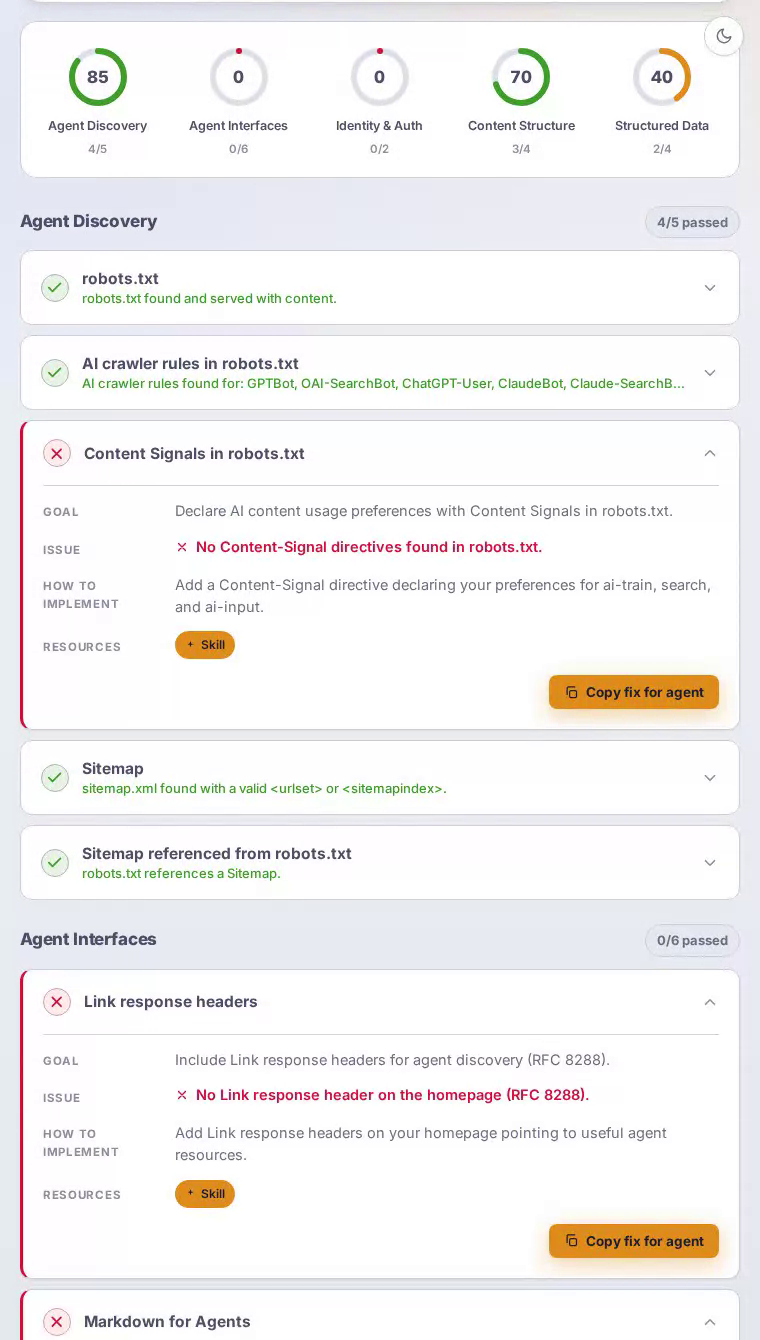
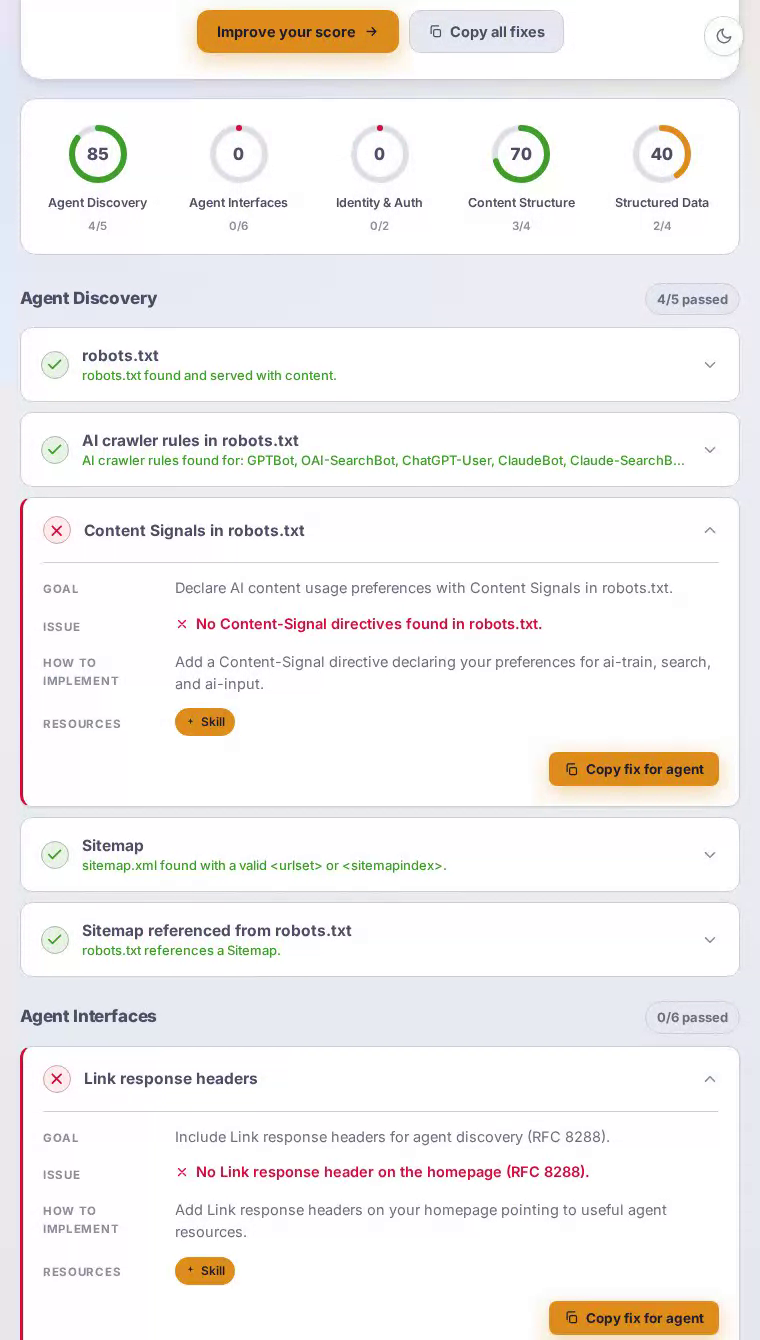
When an AI crawler visits Mosquito Joe, it encounters a well-organized franchise site promoting mosquito, tick, and flea control for residential backyards and commercial outdoor spaces. Content structure scores 70 — headings, service descriptions, and page hierarchy are legible. Structured data sits at 40, meaning partial schema markup is present but not comprehensive enough to feed AI-driven local search reliably. Agent discovery reaches 85, reflecting a crawlable, well-formed robots.txt. What the agent cannot do: negotiate cleaner content formats, locate any machine-actionable interface, or verify the brand's identity. For a service brand whose demand spikes in spring and is increasingly driven by voice and AI assistant queries, those gaps cost real referrals.
Where it loses points
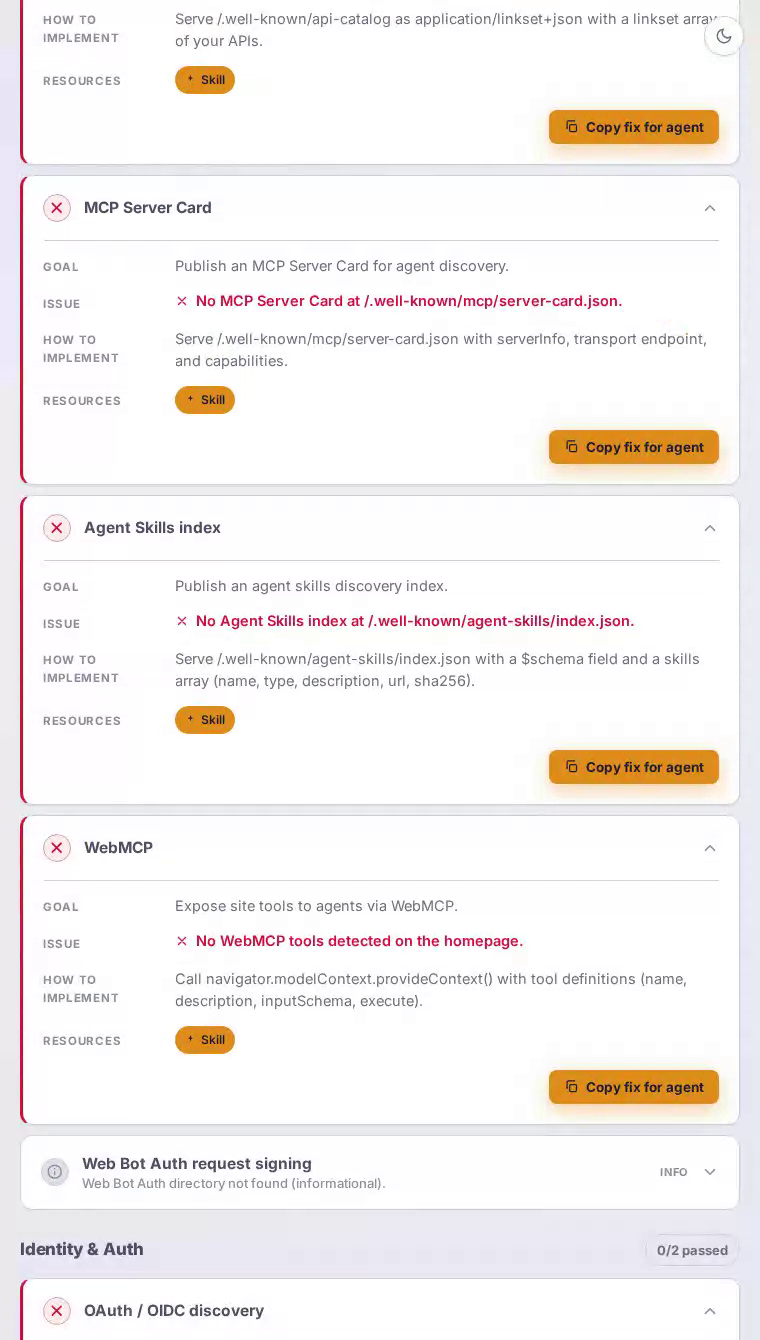
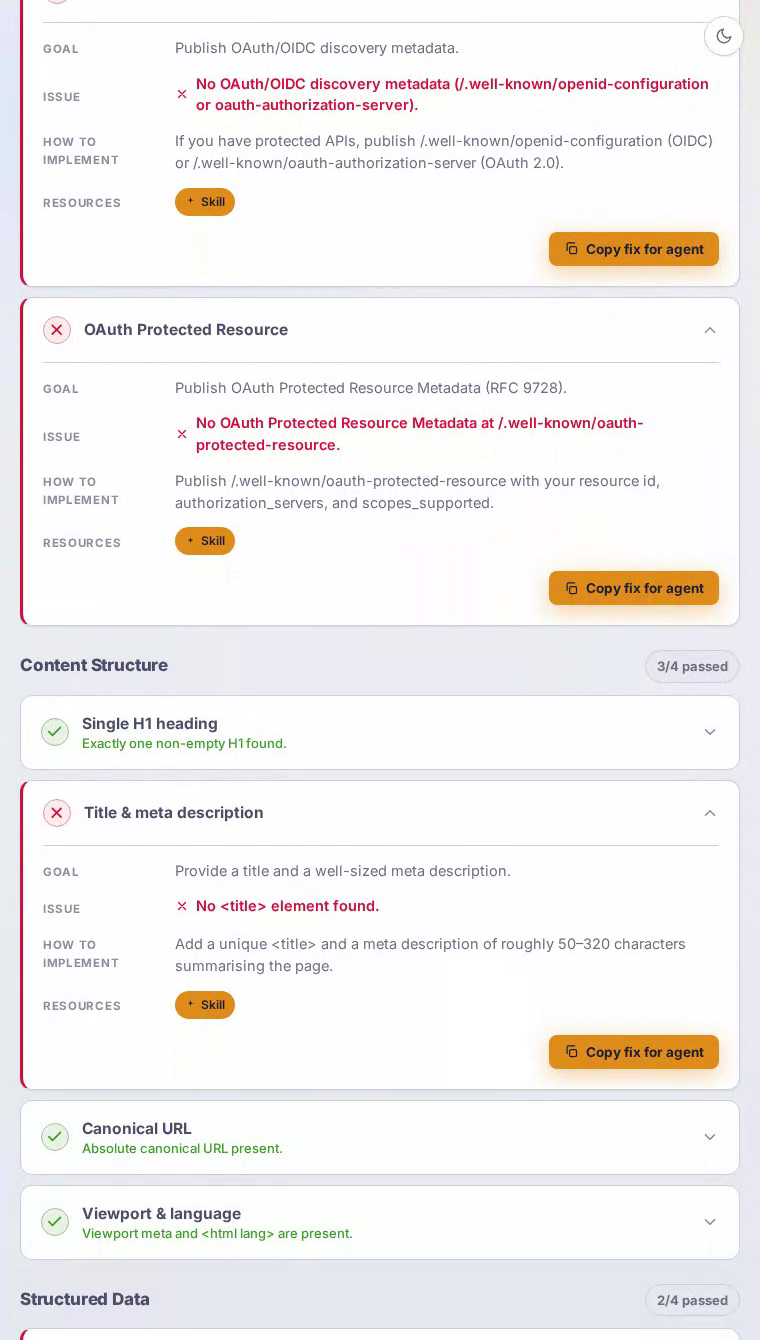
Agent interfaces and identity authentication both score zero — AI agents can find Mosquito Joe but have no mechanism to interact with or verify it once they do.
How to fix it
Three concrete changes would immediately expand Mosquito Joe's agentic surface and put it in front of AI assistants fielding outdoor pest-control queries from homeowners.
Content Signals in robots.txt
Declare AI content preferences explicitly so crawlers and training pipelines know how Mosquito Joe's pages may be used.
The scan found no Content-Signal directives in robots.txt, leaving AI systems to guess whether the site permits search indexing, agent queries, or training data use.
Add a Content-Signal block to robots.txt — for example 'Content-Signal: ai-input=allow, search=allow, ai-train=disallow' — directly below the existing User-agent rules. This two-line addition is already read by major AI crawlers and removes ambiguity that causes cautious systems to deprioritize unlabeled content.
MCP Server Card
Publish a machine-readable server card so AI agent frameworks can auto-discover what Mosquito Joe's site exposes programmatically.
No MCP Server Card was found at /.well-known/mcp/server-card.json, so Model Context Protocol clients have no automated path to connect.
Deploy a static JSON file at /.well-known/mcp/server-card.json with at minimum serverInfo, a transport endpoint, and a capabilities block. For a franchise, even a read-only card advertising location-lookup or service-area capabilities is enough to appear in AI assistant integrations that pull from the MCP ecosystem.
Markdown for Agents
Return a clean Markdown version of pages when AI agents request it, reducing parsing noise and improving factual accuracy in citations.
The site returns the same HTML response for all Accept headers; agents sending Accept: text/markdown receive full HTML markup, forcing lossy DOM parsing.
Add content negotiation server-side: when the incoming Accept header includes text/markdown, respond with the page's core copy — service descriptions, coverage areas, FAQs — formatted as plain Markdown with Content-Type: text/markdown. This is exactly the kind of clean, structured text AI assistants cite when homeowners ask which mosquito control services operate in their zip code.
Common questions
Why does Mosquito Joe score well on agent discovery but land at only 42 overall?
Does a 42/100 AEO score affect how often Mosquito Joe appears in AI-generated answers?
Is publishing an MCP Server Card realistic for a large franchise network like Mosquito Joe?
Is your own site ready for AI?
Run the same five-category analysis on any URL. Free, no account needed to start.
Check your own website free