How AI reads TruGreen
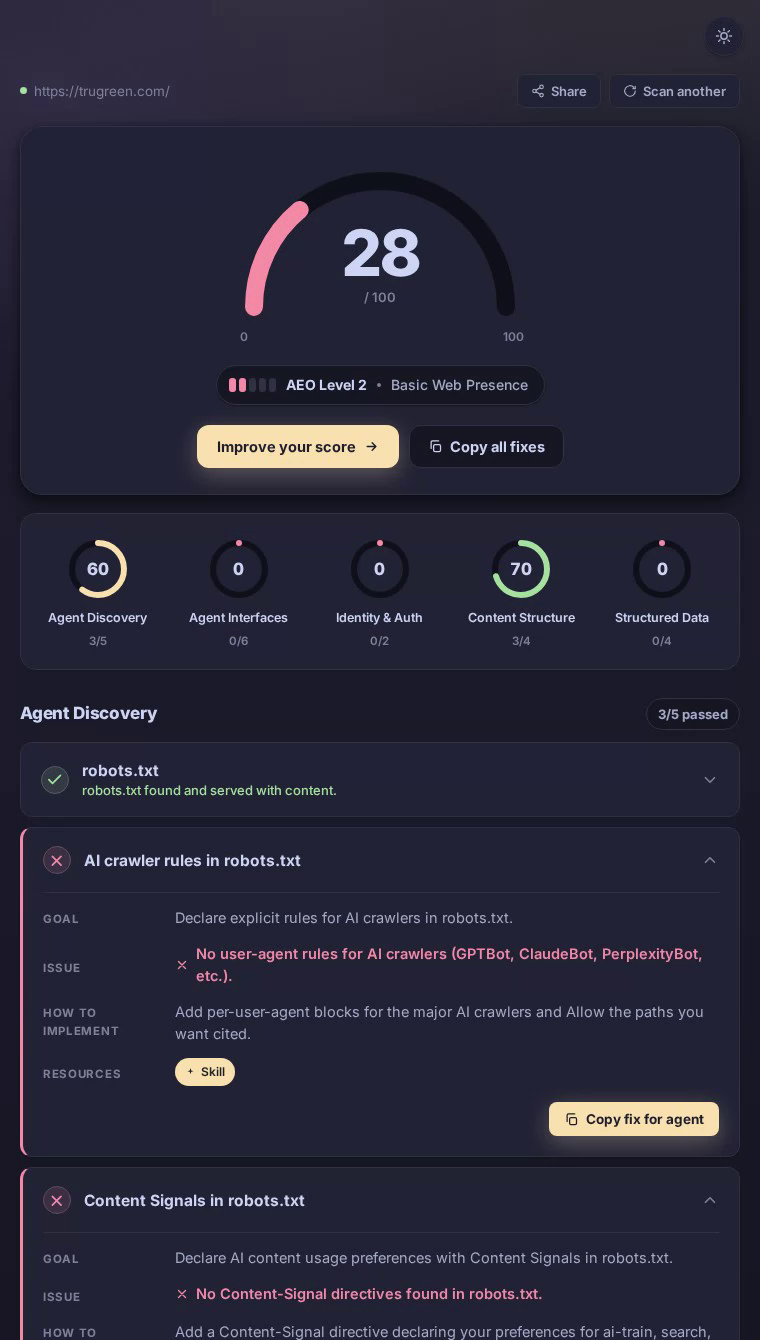
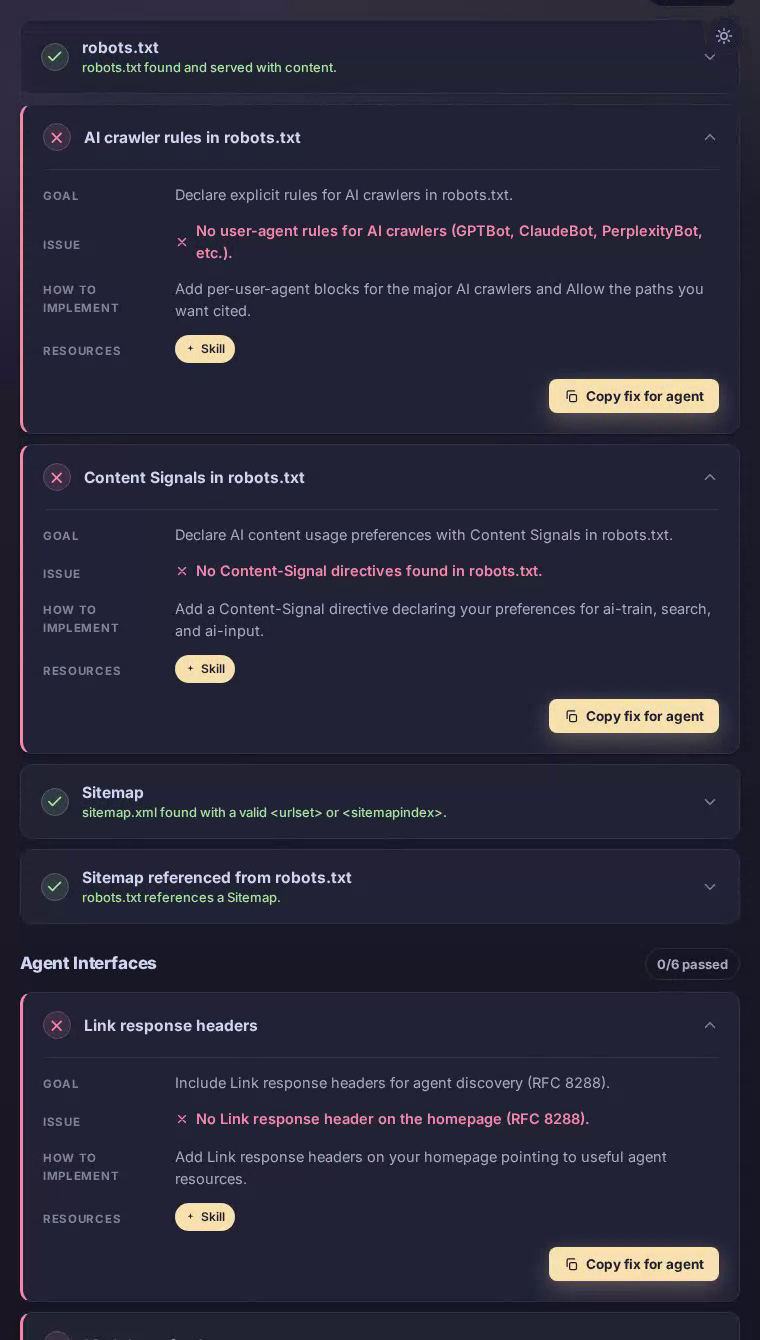
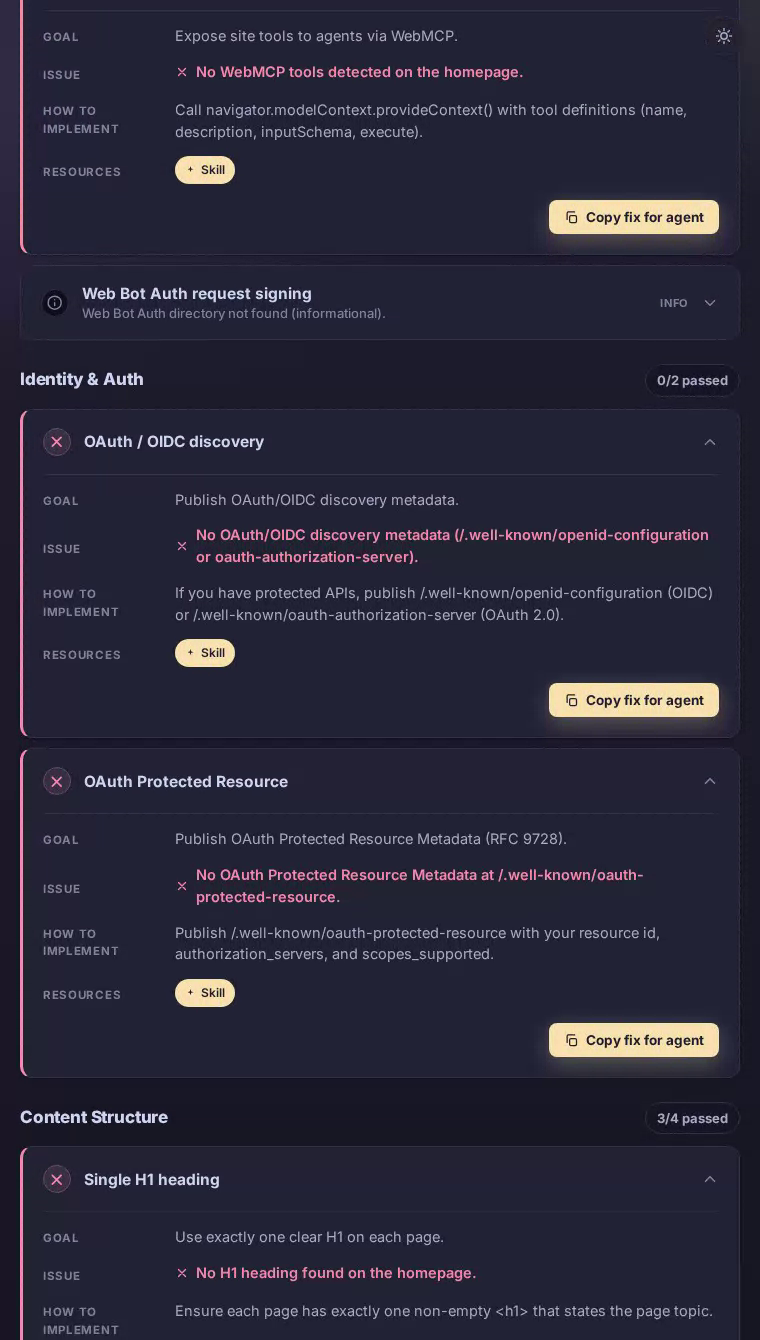
TruGreen earned an AEO score of 28 out of 100, placing it at Level 2. AI agents can parse some homepage content and detect reasonable page structure, but the absence of structured data, agent interfaces, and explicit crawler declarations leaves most of the site invisible to answer engines.
What AI sees
When an AI agent visits TruGreen's homepage today, it encounters a content-rich lawn care site with moderate structural clarity but almost no machine-readable metadata.
The homepage delivers usable text about TruGreen's lawn treatment plans, service areas, and seasonal offers — enough for a basic extraction of who the company is and what it sells. Content structure scores a respectable 70, meaning headings and copy are reasonably organized. Agent discovery reaches 60, partly because the domain is well-known and broadly crawlable. But beyond surface-level text, agents hit a wall: structured data is entirely absent (score 0), so product details, service areas, and pricing signals cannot be reliably extracted. There are no machine-readable interfaces, no authentication signals, and no well-known endpoints that would let an AI agent interact with or programmatically represent TruGreen's service offerings.
Where it loses points
The most damaging gaps are agent interfaces and structured data — both scoring zero — meaning AI tools cannot reliably cite, integrate, or represent TruGreen's lawn care plans inside automated answer workflows.
How to fix it
Three targeted changes would move TruGreen's AEO score meaningfully and signal to AI crawlers that this is a trusted, citable source worth surfacing to homeowners.
Declare AI crawler rules in robots.txt
Establish explicit per-agent permissions so AI crawlers know exactly which paths they may index and cite.
TruGreen's robots.txt contains no user-agent rules for GPTBot, ClaudeBot, PerplexityBot, or any other AI crawler.
Add individual User-agent blocks for each major AI crawler with Allow directives covering service pages, FAQs, and plan descriptions. Include a Content-Signal directive declaring preferences for ai-train, search, and ai-input so downstream models handle the content correctly.
Publish an MCP Server Card
Give AI agents a machine-readable endpoint describing TruGreen's available tools, transport protocol, and capabilities.
No MCP Server Card exists at /.well-known/mcp/server-card.json, so agent frameworks cannot auto-discover how to interact with TruGreen programmatically.
Serve /.well-known/mcp/server-card.json with serverInfo (name, version), a transport endpoint, and a capabilities block listing available actions such as quote lookup or service-area check. This single file unlocks integration with any MCP-compatible AI agent.
Publish an API catalog at /.well-known/api-catalog
Enable automated discovery of TruGreen's APIs so AI orchestration tools can invoke them without manual configuration.
No API catalog exists at /.well-known/api-catalog per RFC 9727, leaving any existing APIs completely invisible to agent pipelines.
Serve /.well-known/api-catalog as application/linkset+json containing a linkset array that references available APIs — at minimum a quote or service-area endpoint. Even a one-entry catalog signals to AI systems that TruGreen is agent-ready.
Common questions
Why does TruGreen score only 28/100 on AEO despite being a nationally recognized lawn care brand?
What would happen if TruGreen published an MCP Server Card today?
Does TruGreen's content structure score of 70 mean AI agents can already understand its service pages?
Is your own site ready for AI?
Run the same five-category analysis on any URL. Free, no account needed to start.
Check your own website free