How AI reads Stripe
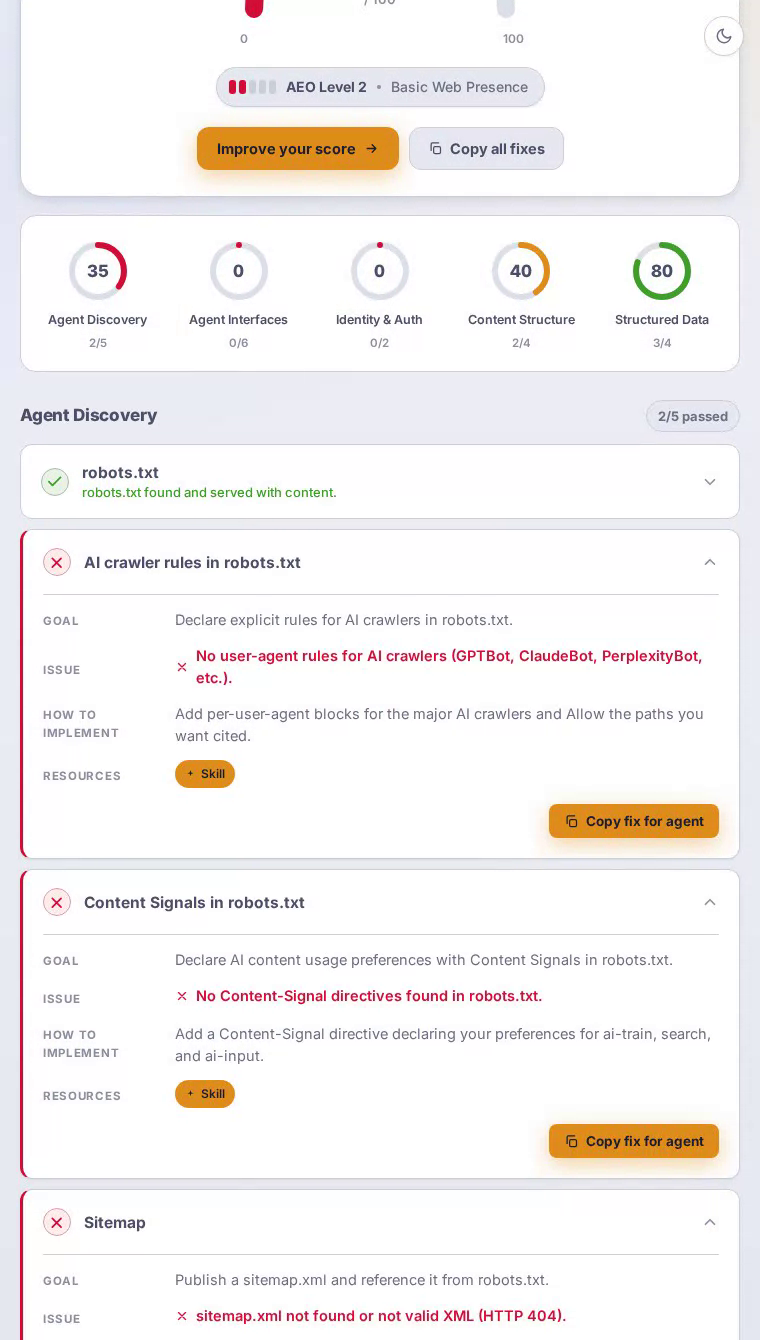
Stripe scores 34 out of 100 on our AEO analyzer, placing it at readiness level 2. Despite being the internet's default payment infrastructure, the site is nearly opaque to AI agents: both agent interface categories score zero, meaning no automated system can discover, authenticate with, or interact with Stripe programmatically through modern agent protocols.
What AI sees
An AI agent landing on Stripe's homepage today finds polished structured data but almost nothing designed to help it understand what to do next.
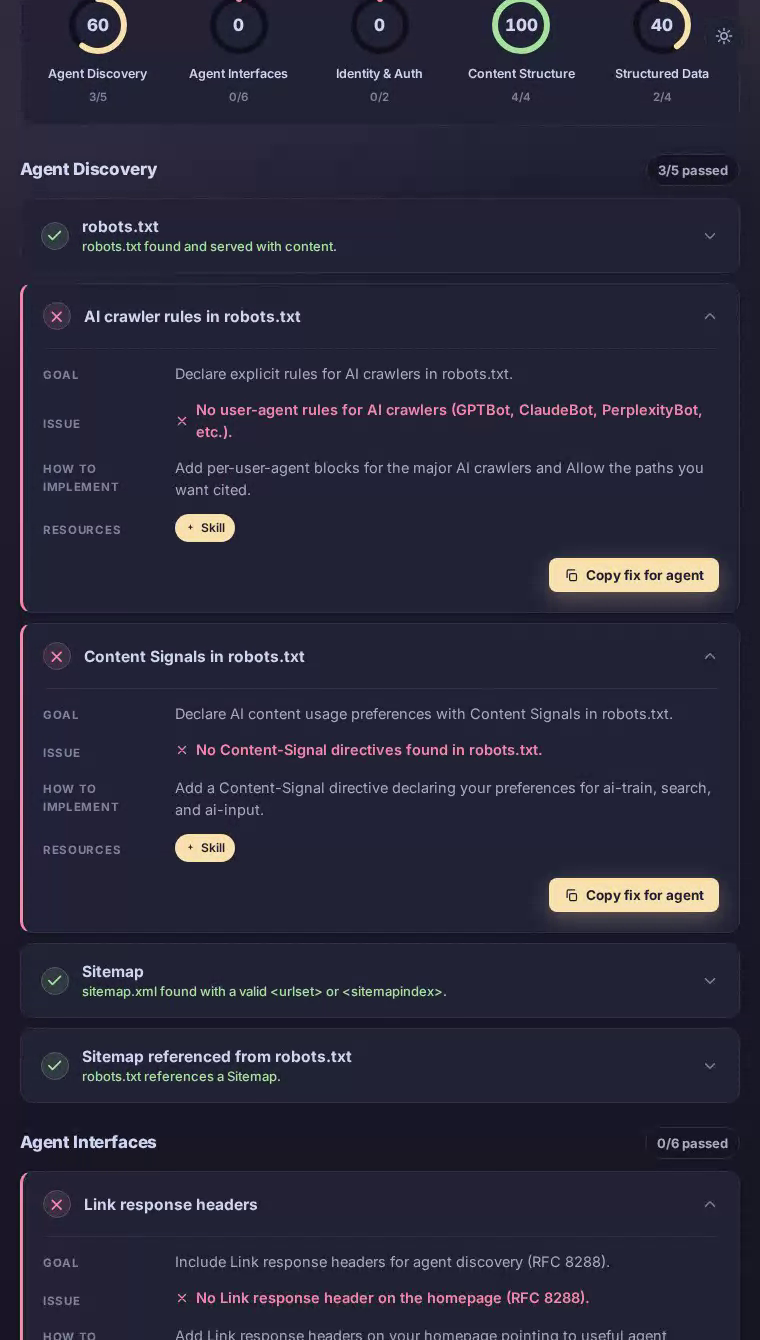
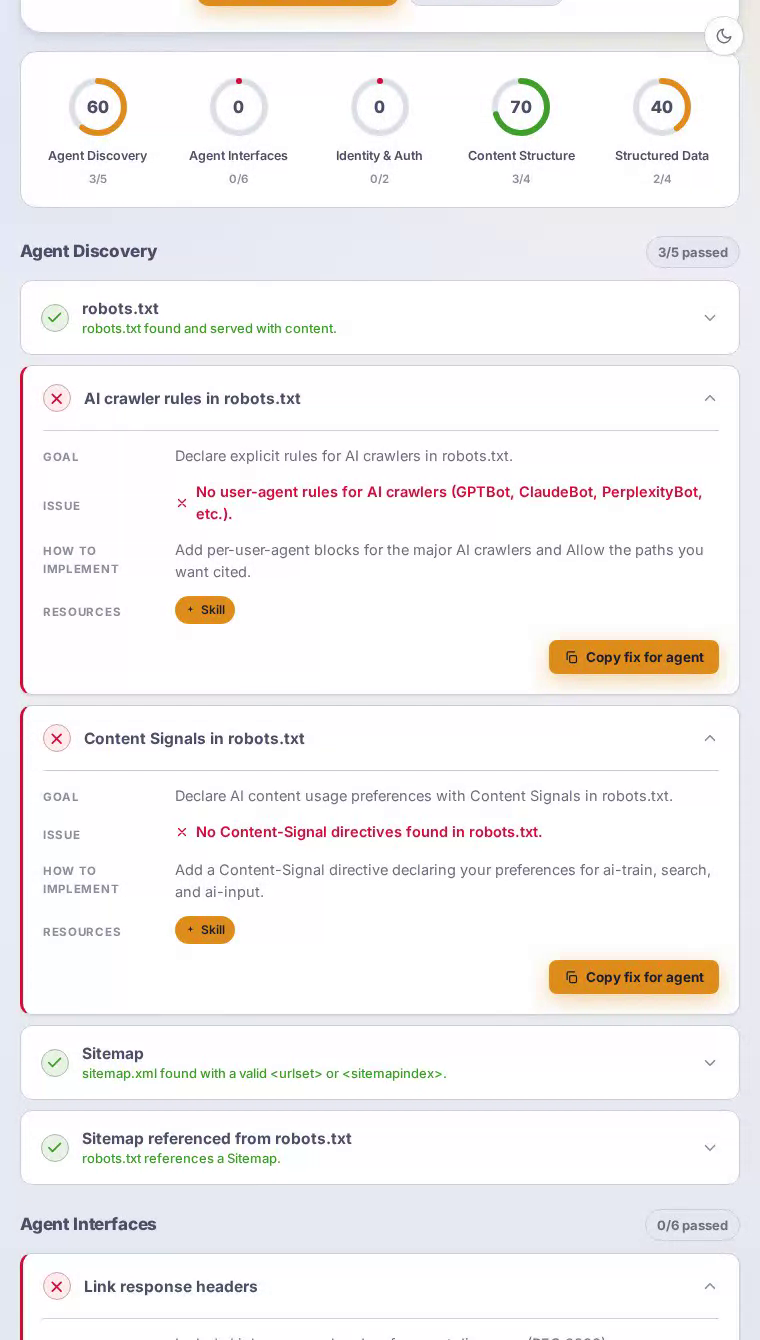
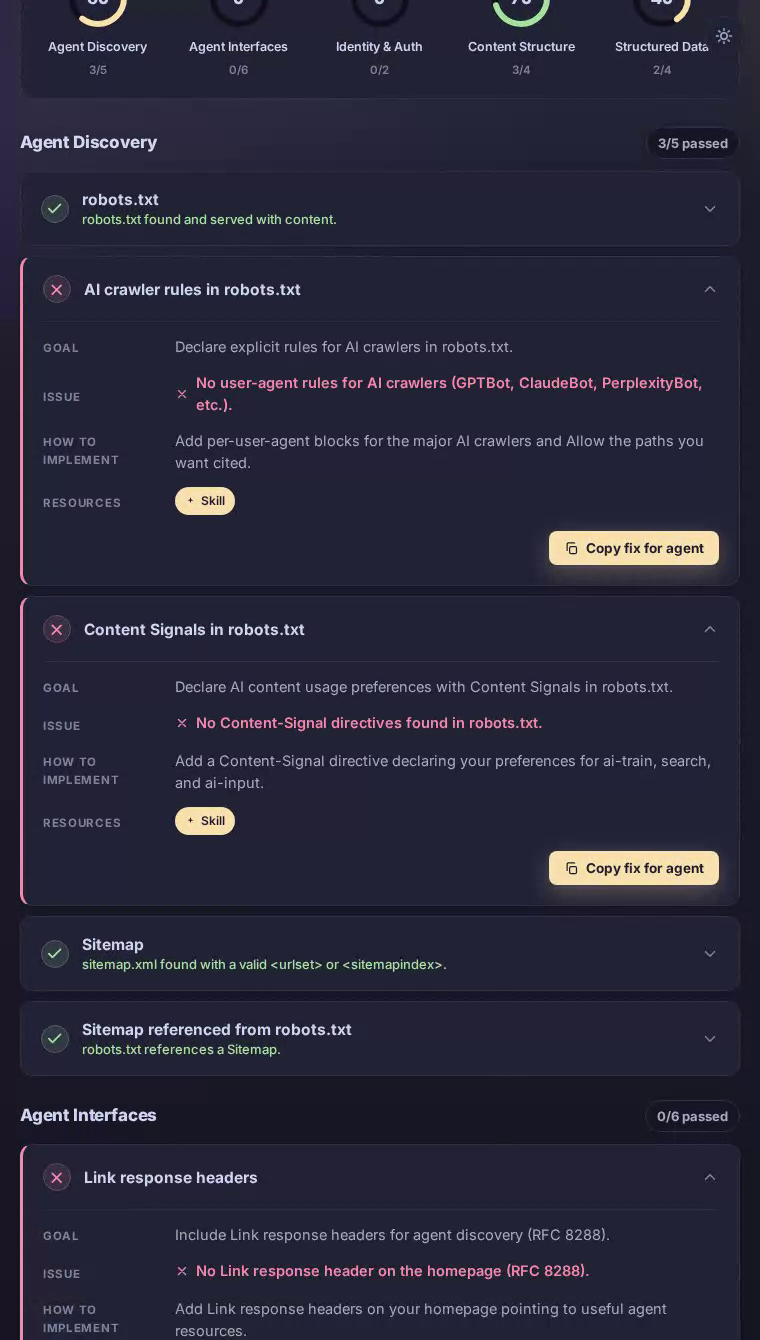
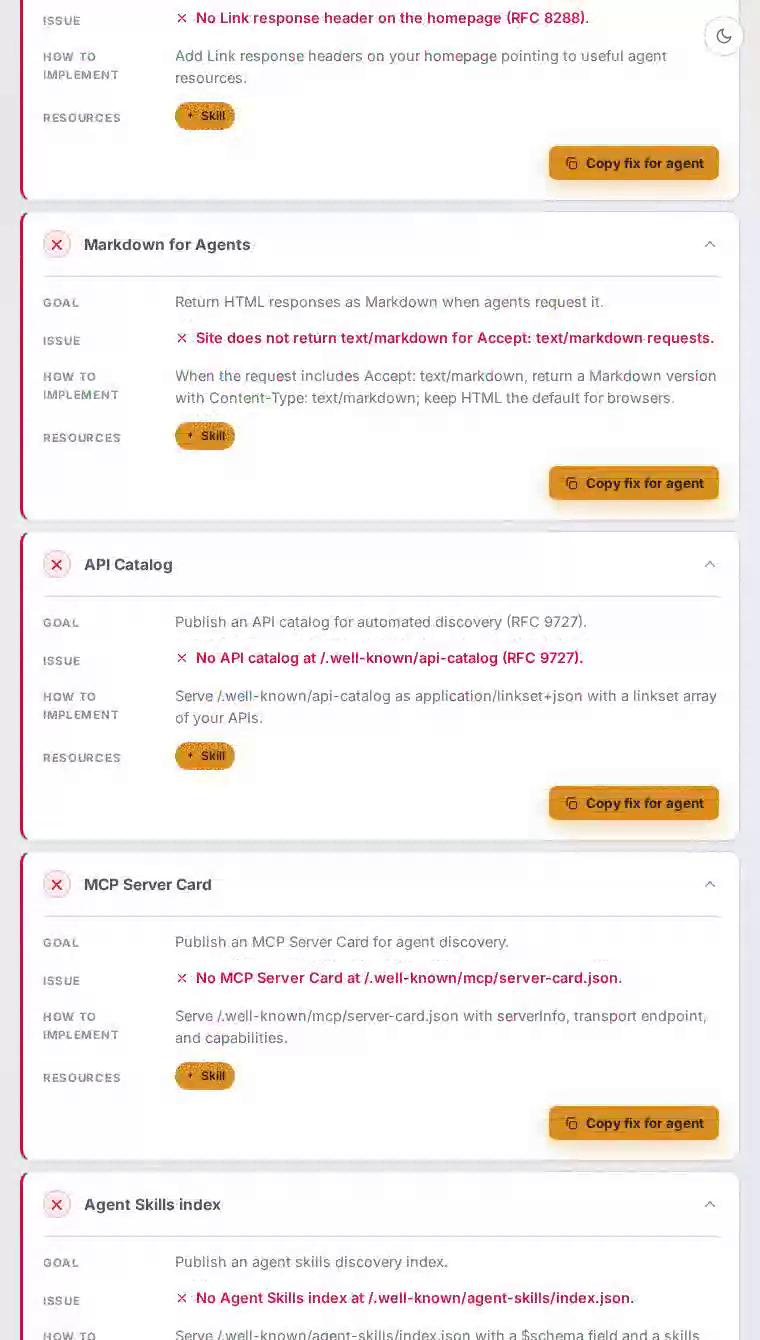
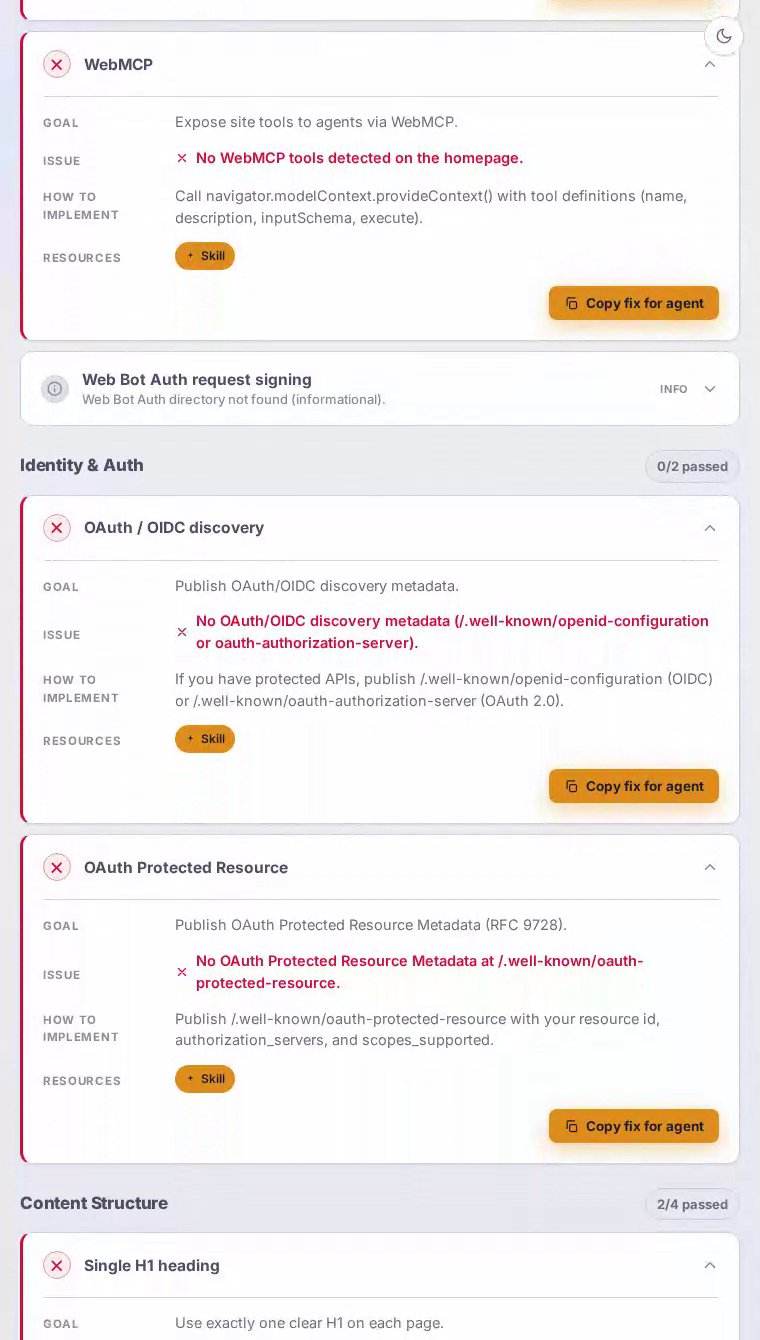
When an AI crawler or autonomous agent fetches Stripe's homepage, it finds solid schema markup — structured_data scores 80 out of 100, the site's only real strength. Content structure reaches 40, meaning headings and semantic HTML are partially usable. But the agent quickly hits dead ends: no Markdown alternative response, no Link headers pointing to machine-readable resources, no sitemap to map the documentation landscape, and no well-known endpoints declaring what Stripe's APIs can do. For a company whose entire value proposition is developer infrastructure, the irony is sharp — Stripe's own site offers far less to an autonomous software agent than it does to a human engineer reading the docs.
Where it loses points
The two categories that define modern agentic interoperability — agent interfaces and identity and authentication — both score zero, an almost impossible gap for a platform that processes hundreds of billions in payments annually.
How to fix it
Three structural additions would immediately lift Stripe's discoverability across every major AI answer engine and autonomous agent runtime.
Publish an MCP Server Card
Declare Stripe's agent transport endpoint and capabilities at a standardized well-known path so any MCP-compatible agent can auto-configure a connection.
No MCP Server Card exists at /.well-known/mcp/server-card.json, leaving every agent framework unable to auto-discover Stripe's capabilities.
Serve a JSON document at /.well-known/mcp/server-card.json containing serverInfo, the transport endpoint URL, and a capabilities array listing tools like charge-create or payment-intent-retrieve. This single file turns Stripe from invisible to instantly connectable for any MCP-aware agent.
Add an RFC 9727 API Catalog
Expose a machine-readable catalog of Stripe's API surface so automated discovery tools and AI orchestrators can enumerate available operations without human documentation review.
No API catalog exists at /.well-known/api-catalog, meaning agents must scrape docs rather than query a structured manifest.
Publish /.well-known/api-catalog as application/linkset+json with a linkset array referencing the Stripe REST API, Webhooks endpoint, and SDK references. Given Stripe's API depth, this catalog becomes the single handshake point that lets any orchestration layer understand the full scope of available payment operations.
Declare AI Crawler Rules in robots.txt
Give GPTBot, ClaudeBot, PerplexityBot, and peer crawlers explicit per-user-agent directives so Stripe controls exactly which documentation paths get cited in AI answers.
Stripe's robots.txt contains no user-agent rules for any major AI crawler, leaving indexing behavior entirely up to each crawler's defaults.
Add dedicated user-agent blocks for GPTBot, ClaudeBot, PerplexityBot, and other major AI crawlers, with explicit Allow directives for /docs, /api, and key landing pages. Pair this with a Content-Signal directive declaring ai-input: allowed so answer engines treat Stripe's documentation as a citable, authoritative source.
Common questions
Why does Stripe score so low on AEO when it has great structured data?
Does a low AEO score affect how ChatGPT or Perplexity answer questions about Stripe?
How long would it take Stripe's engineering team to fix these gaps?
Is your own site ready for AI?
Run the same five-category analysis on any URL. Free, no account needed to start.
Check your own website free