How AI reads Stripe
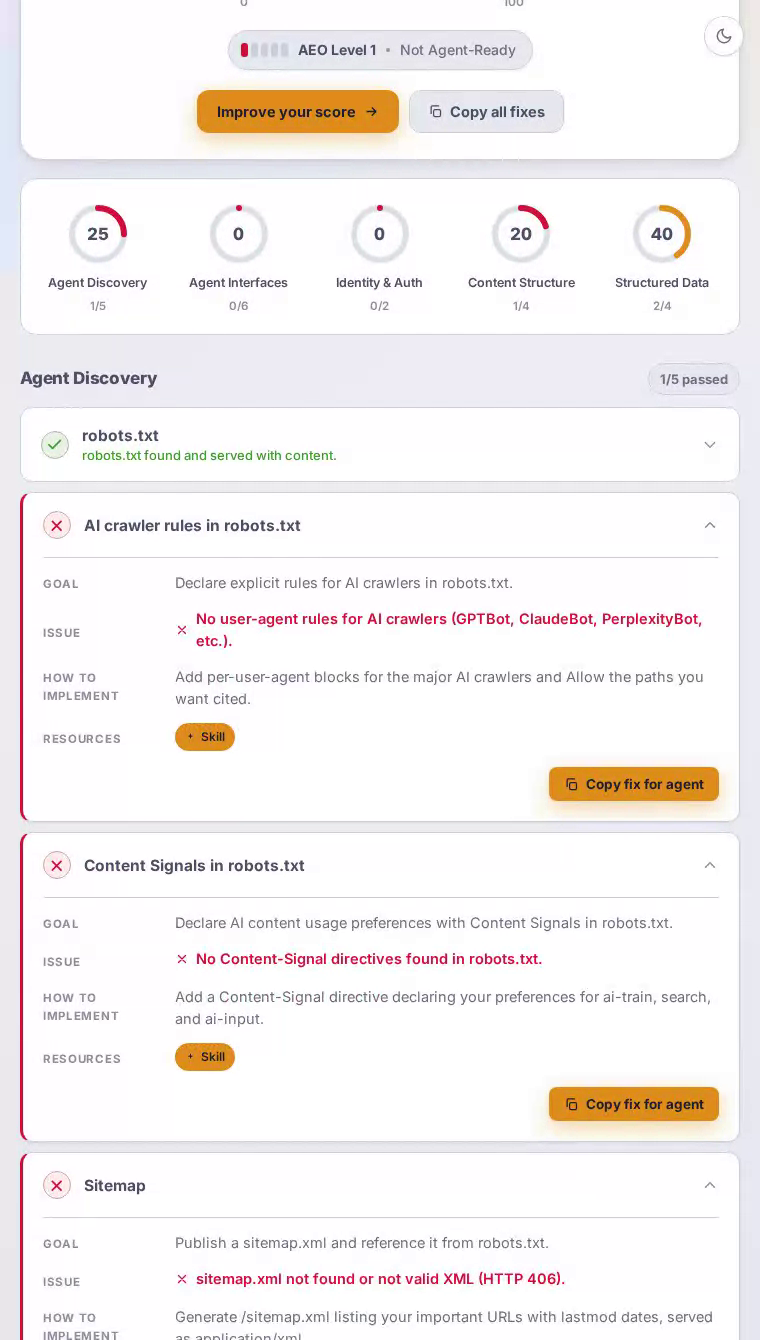
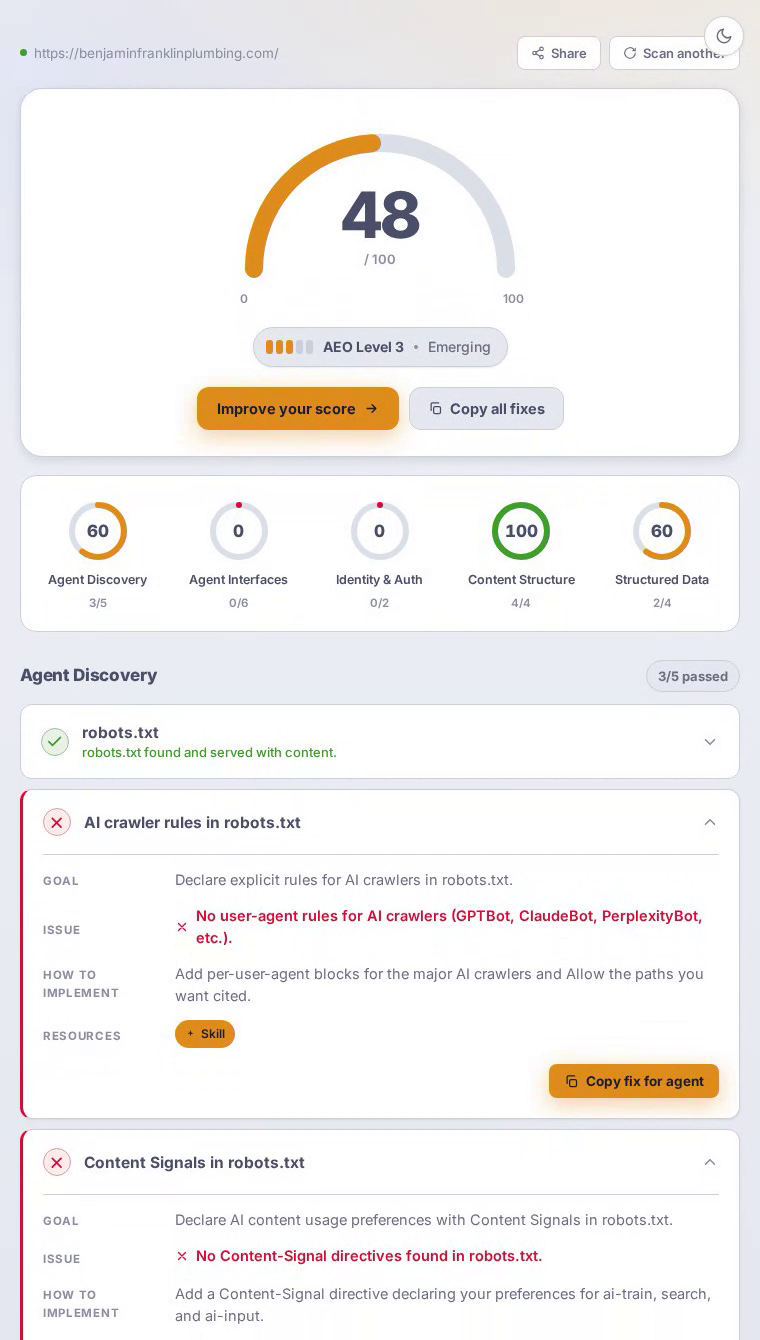
Stripe scores 34 out of 100 on AEO readiness. Despite powering payments for millions of developers worldwide, the platform leaves AI agents largely in the dark: no explicit crawler rules, no machine-readable API catalog, and zero coverage in both agent-interfaces and identity-auth categories.
What AI sees
When an AI agent lands on Stripe's homepage today, it finds polished marketing copy but almost nothing designed for automated consumption.
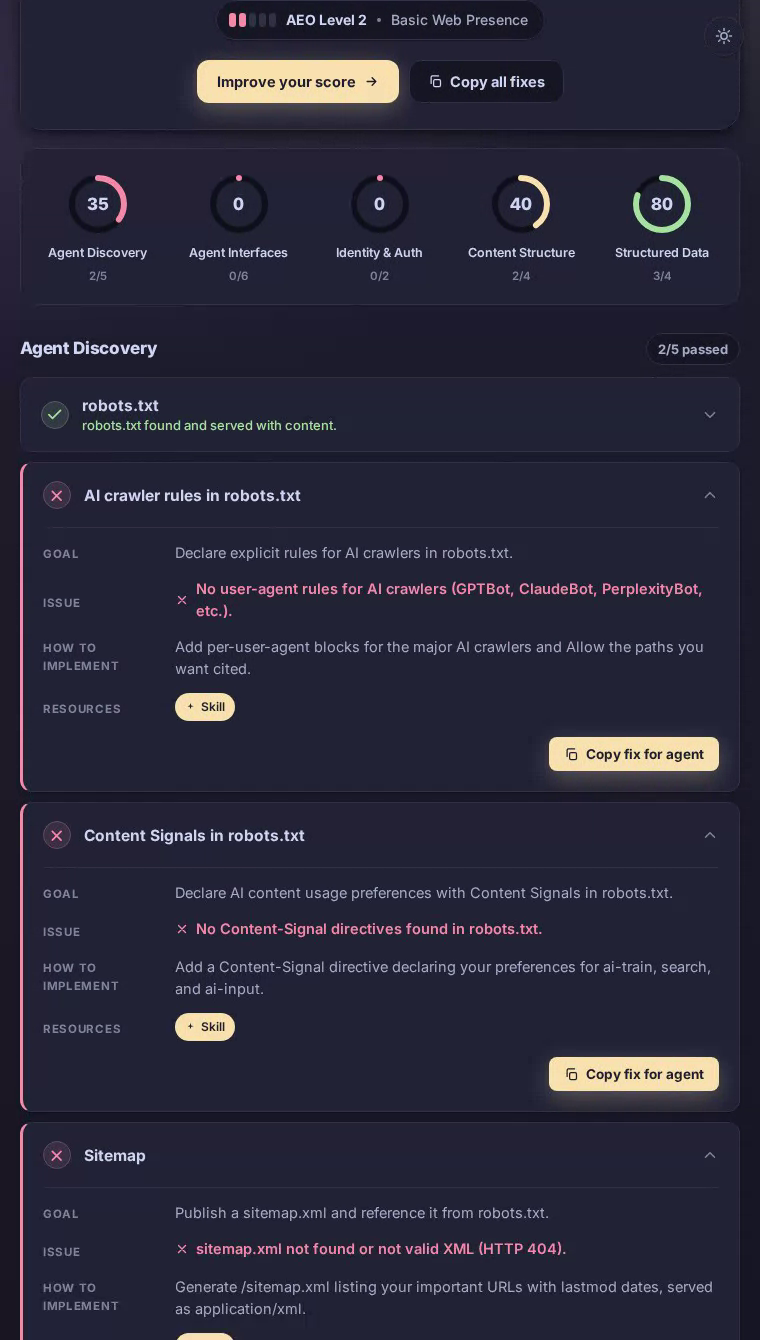
Structured data is Stripe's one bright spot, scoring 80 out of 100 — schema markup is present and helps AI parse product context. Beyond that, the picture dims quickly. There is no sitemap.xml, so an agent must guess which URLs matter. No Link response headers point to developer resources or API endpoints. robots.txt contains no instructions for GPTBot, ClaudeBot, or PerplexityBot, leaving crawl behavior undefined. Content structure reaches 40 out of 100, meaning some hierarchy is legible, but the majority of agent-oriented signals — markdown fallback, well-known discovery endpoints, MCP server card — are simply absent.
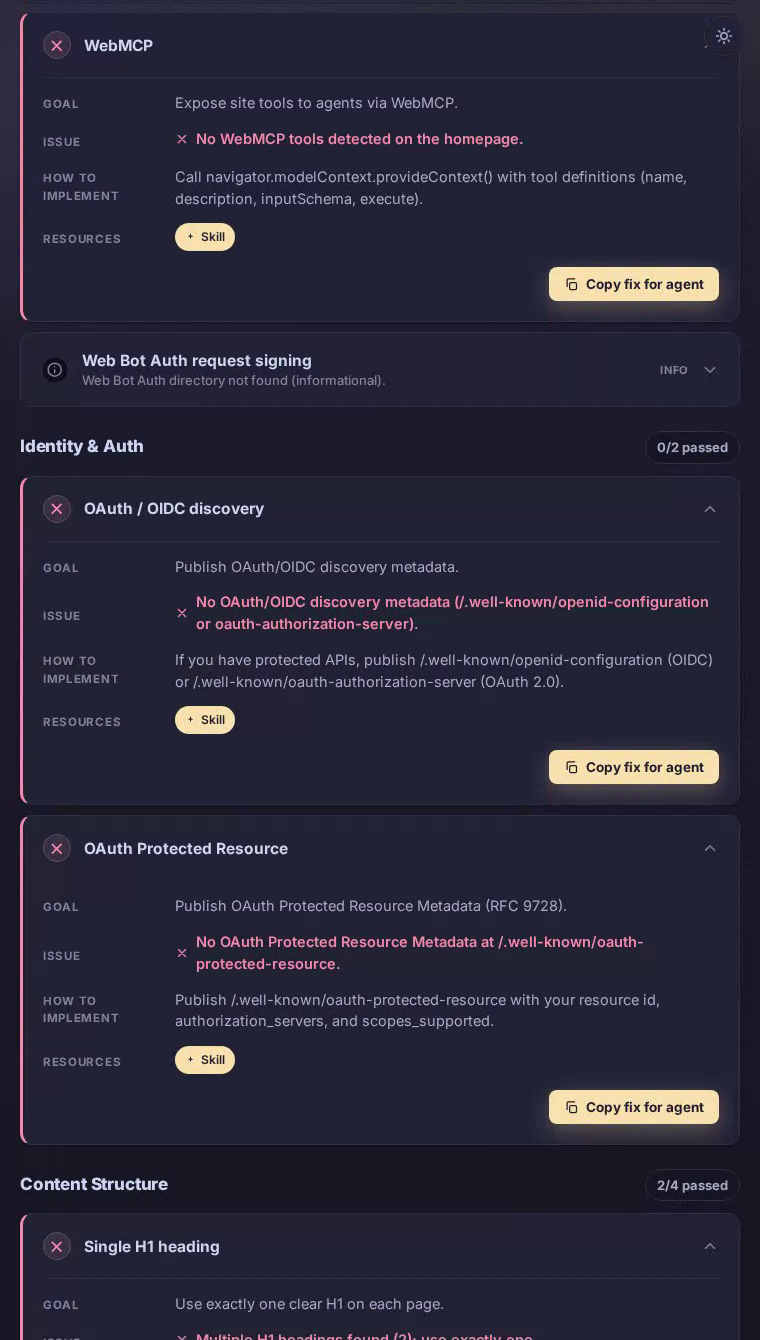
Where it loses points
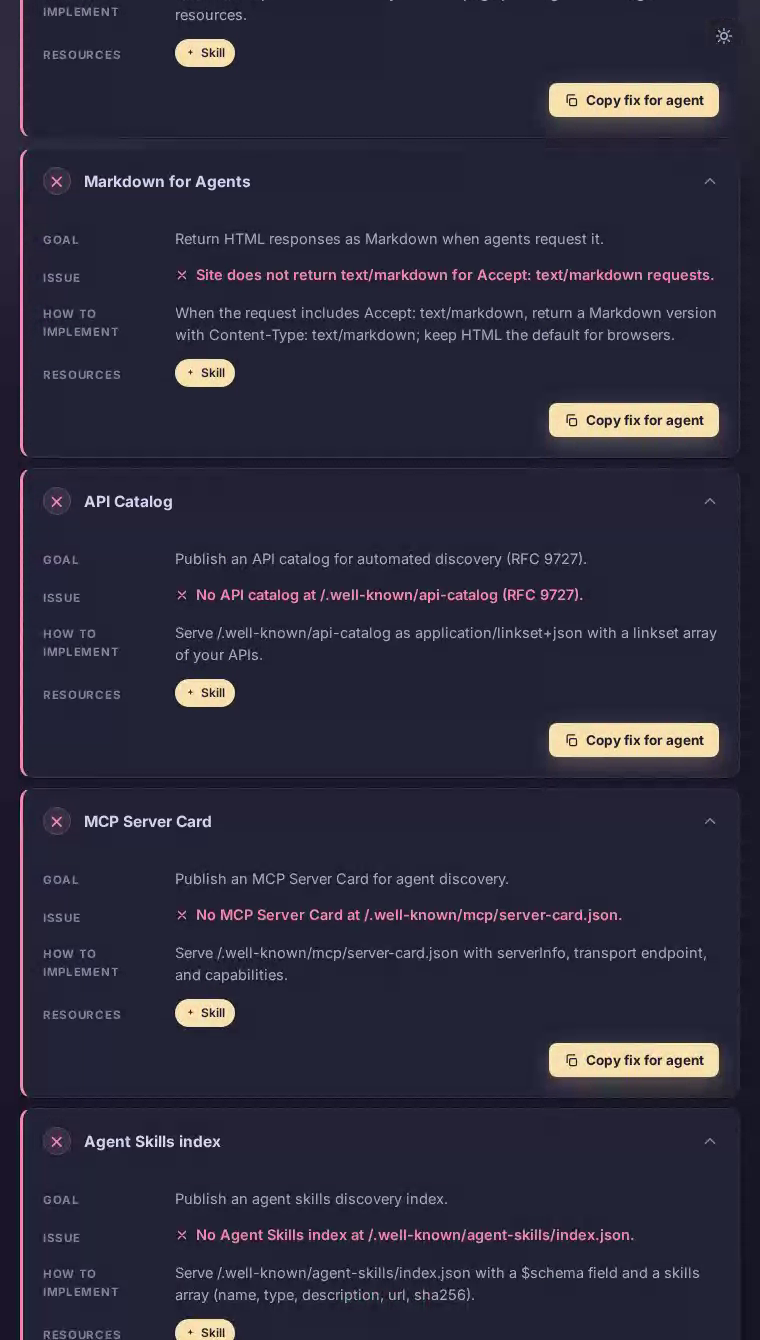
The two categories where Stripe scores zero — agent interfaces and identity/auth — expose the sharpest gap between the brand's developer-first reputation and its actual machine readability.
How to fix it
Three changes would move the needle most for Stripe given its role as the de-facto API infrastructure layer for the internet.
Declare AI crawler rules in robots.txt
Give each major AI crawler an explicit allow or disallow directive so indexing behavior is deterministic.
Stripe's robots.txt has no user-agent entries for GPTBot, ClaudeBot, PerplexityBot, or any other AI crawler.
Add a dedicated User-agent block for each major AI crawler followed by explicit Allow or Disallow paths. For a developer platform that benefits from AI citation, most paths should be allowed; restrict only internal dashboards and auth routes.
Publish an MCP Server Card
Expose a machine-readable server card at /.well-known/mcp/server-card.json so AI agents can auto-discover Stripe's capabilities.
No MCP Server Card exists at the expected well-known path, so agents cannot programmatically discover Stripe's transport endpoint or capabilities.
Serve /.well-known/mcp/server-card.json with serverInfo, a transport endpoint pointing to the Stripe API, and a capabilities object. This is especially high-value for Stripe because payment orchestration agents already query it by name and need authoritative capability signals.
Publish an API Catalog at /.well-known/api-catalog
Register all public APIs in a machine-readable linkset so agents can discover and invoke them without documentation scraping.
No /.well-known/api-catalog exists — a notable gap for a company whose entire business model is a public API.
Serve /.well-known/api-catalog as application/linkset+json listing core endpoints such as charges, payment intents, subscriptions, and webhooks. A single RFC 9727-compliant file lets any aware agent integrate Stripe without ever reading a documentation page.
Common questions
Why does Stripe score only 34 out of 100 on AEO even though it has extensive API documentation?
What does an agent_interfaces score of 0 mean for a payment platform like Stripe?
Is Stripe's structured data score of 80 enough to offset the gaps in other categories?
Is your own site ready for AI?
Run the same five-category analysis on any URL. Free, no account needed to start.
Check your own website free