How AI reads Portillo's
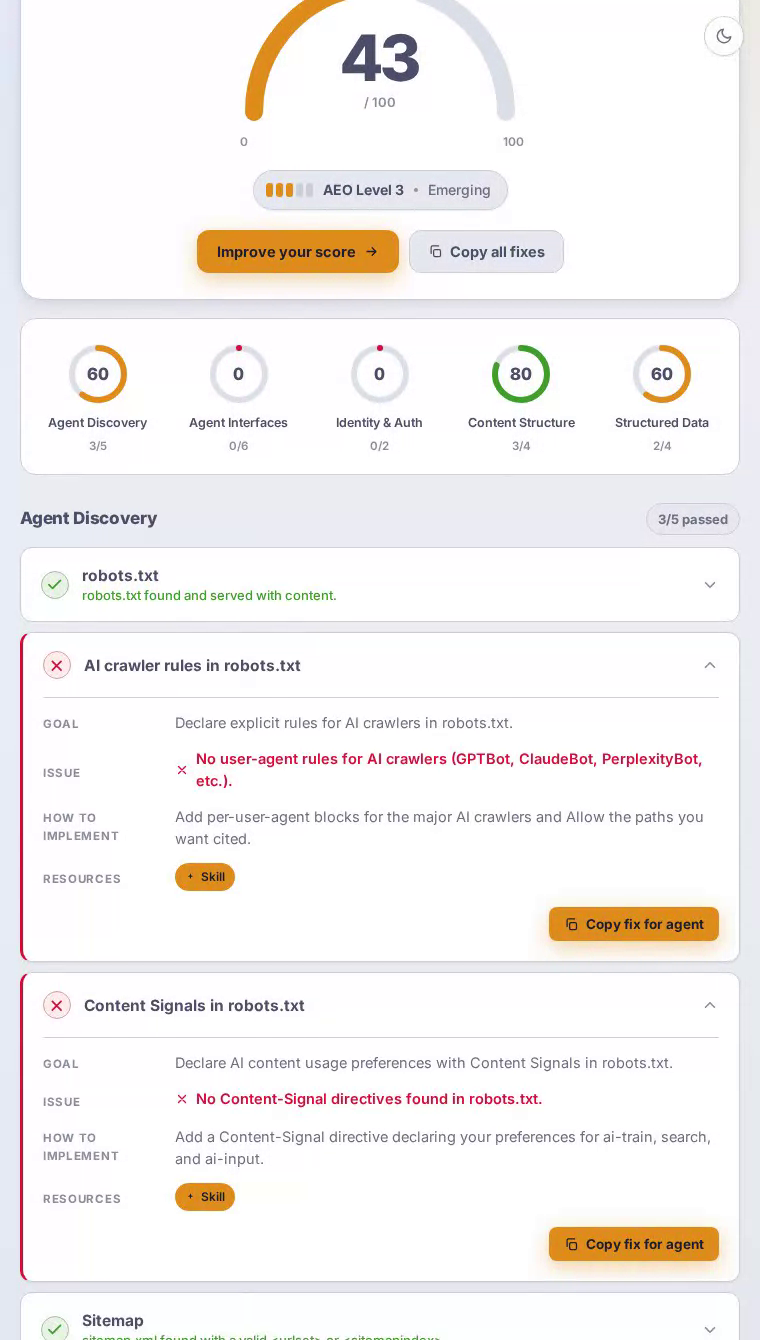
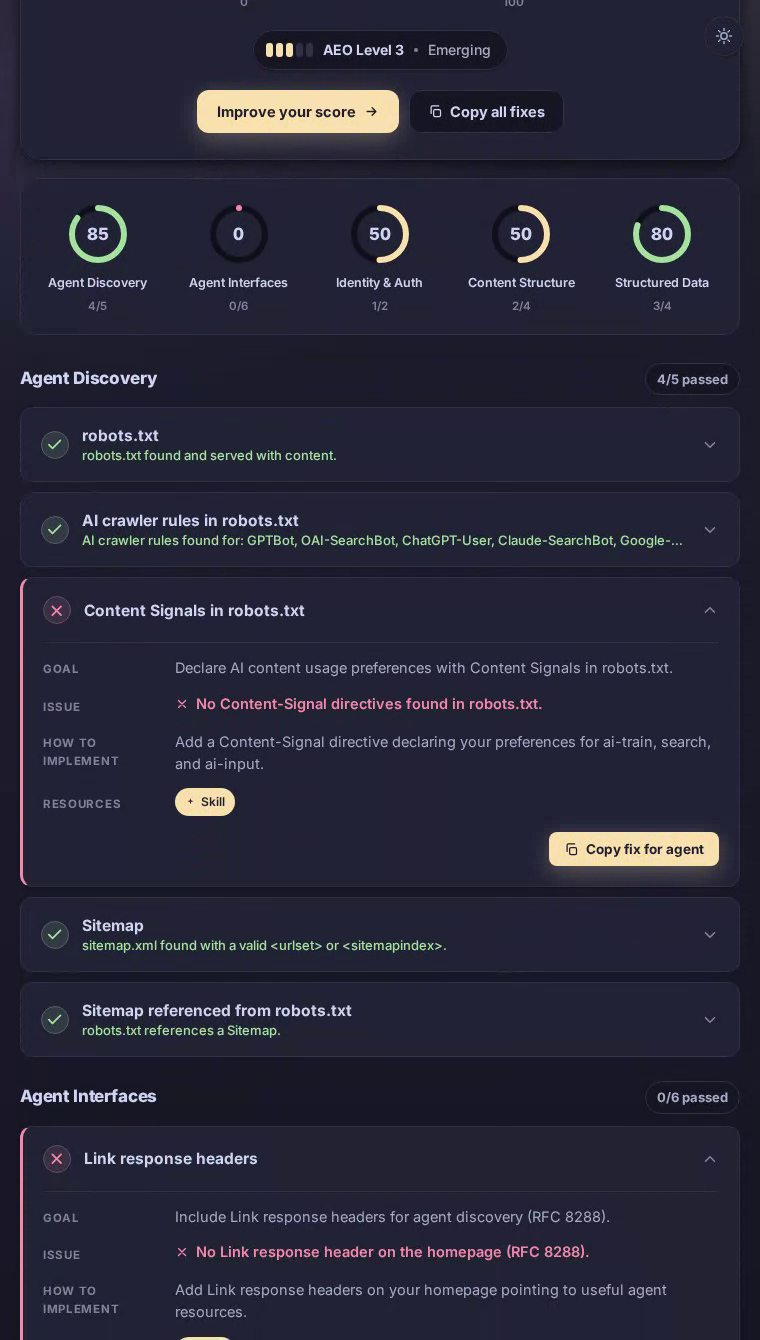
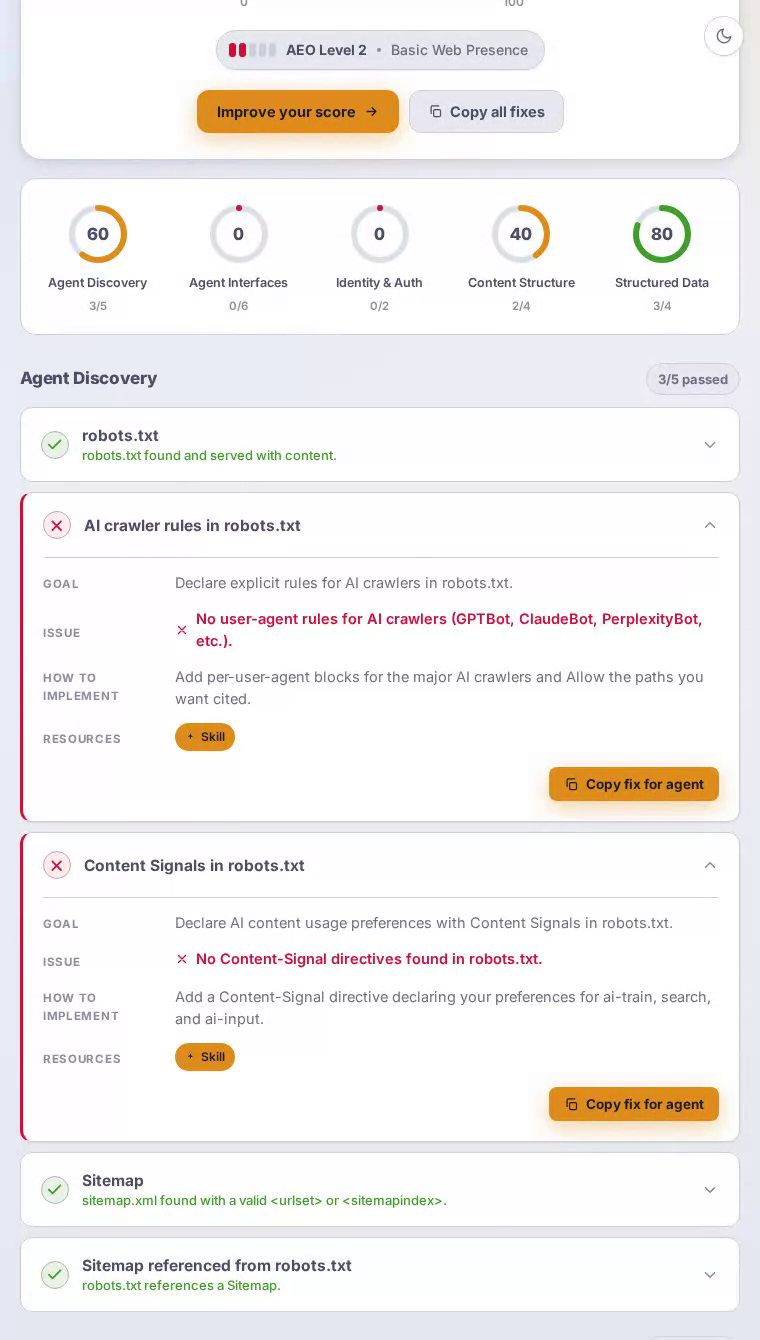
Portillo's earns a 39/100 AEO score at Level 2 readiness. Structured data shines at 80/100, helping answer engines surface hours and menu details, but agent interfaces and identity auth both sit at zero, leaving AI assistants unable to interact with the site beyond passive reading.
What AI sees
An AI agent visiting Portillo's today walks away with solid restaurant facts but no path to programmatic engagement.
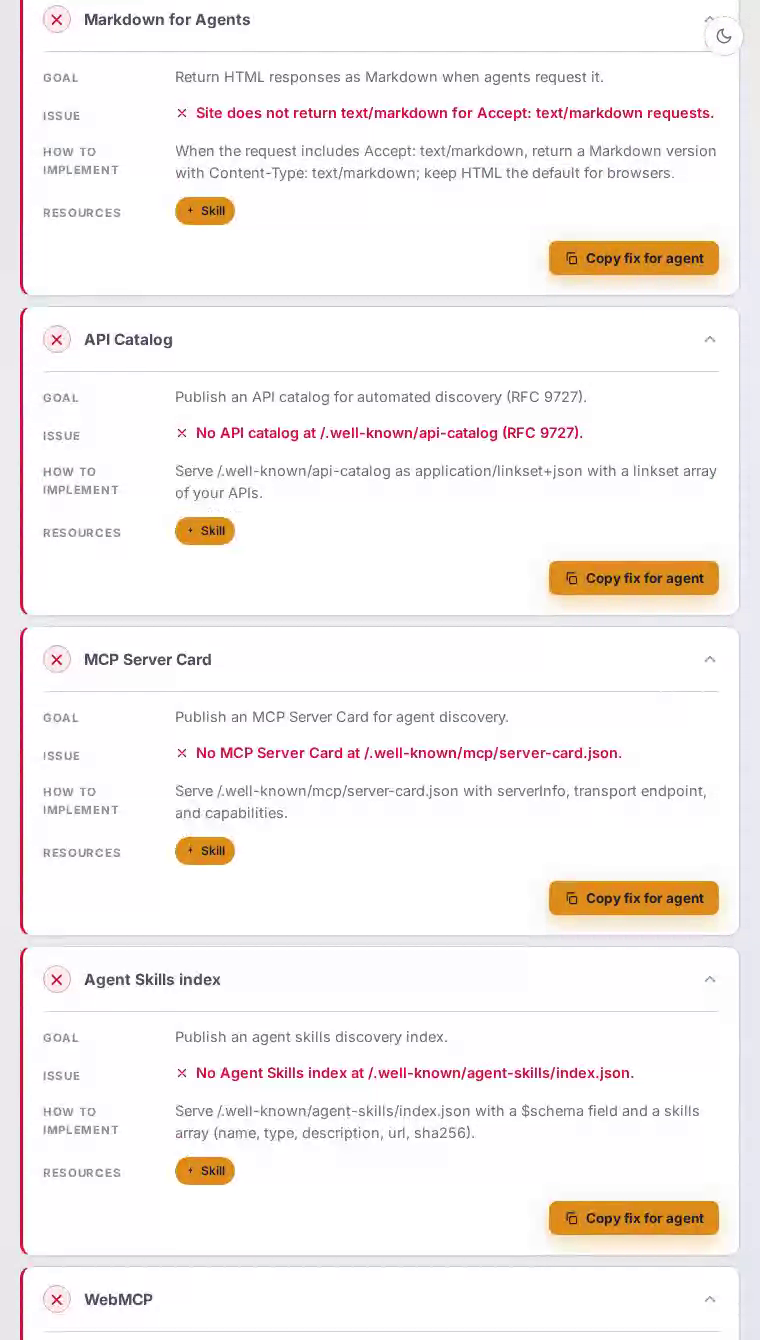
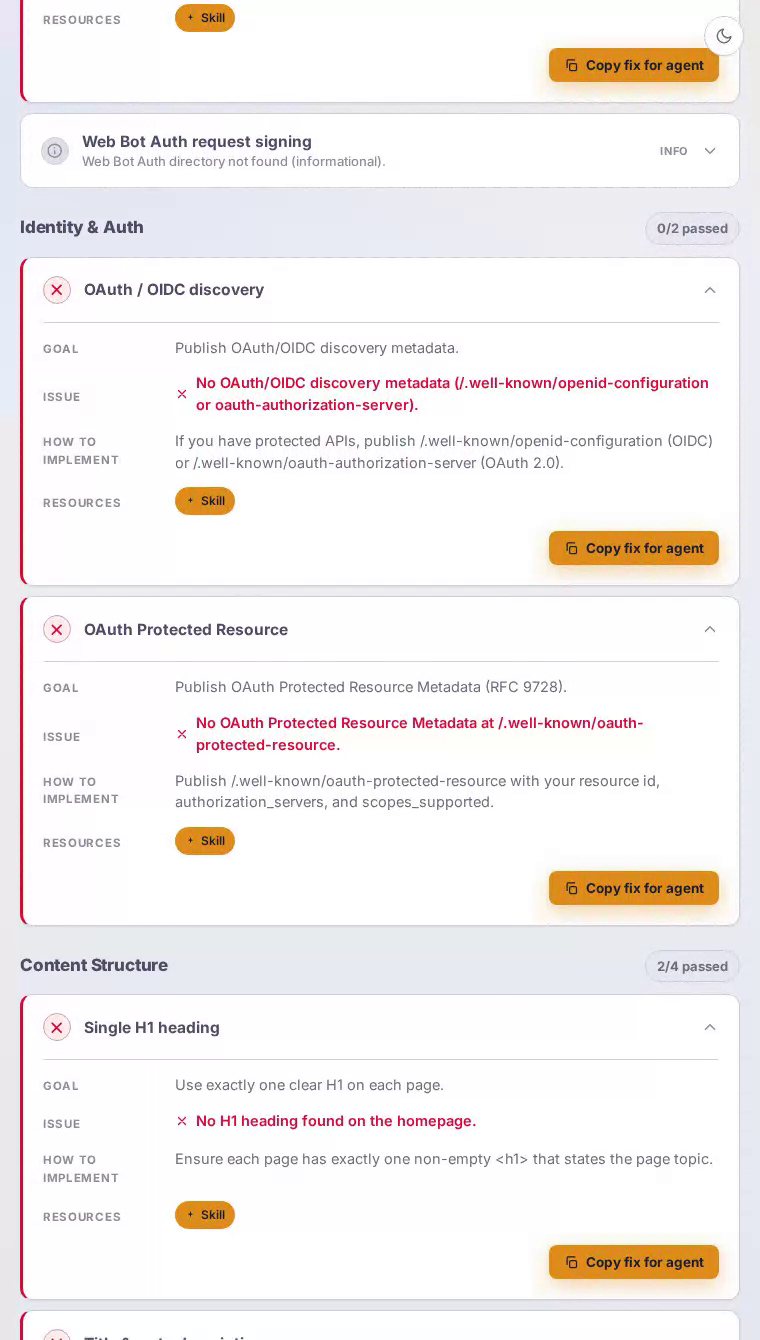
When an AI crawler lands on Portillo's homepage it encounters well-formed structured data covering restaurant locations, menu categories, and operating hours—strong signals for answer engines fielding questions about Chicago-style Italian beef or chocolate cake. Content structure scores a moderate 40, reflecting readable headings and descriptive copy. Everything beyond that passive layer is absent: no Markdown response path, no API catalog, no MCP Server Card, and no explicit AI crawler rules in robots.txt. An agent trying to do more than read static facts is essentially cupping its hands against the glass rather than stepping inside.
Where it loses points
Agent interfaces and identity auth each score zero—the sharpest drag on a brand whose customers ask AI assistants about menus and drive-through locations every day.
How to fix it
Three targeted changes move Portillo's from a site AI agents can only observe to one they can genuinely use.
Declare AI crawler rules in robots.txt
Give major AI crawlers explicit permission rules so they know exactly which paths they may index and cite.
The scan found no user-agent entries for GPTBot, ClaudeBot, PerplexityBot, or any other AI crawler in robots.txt.
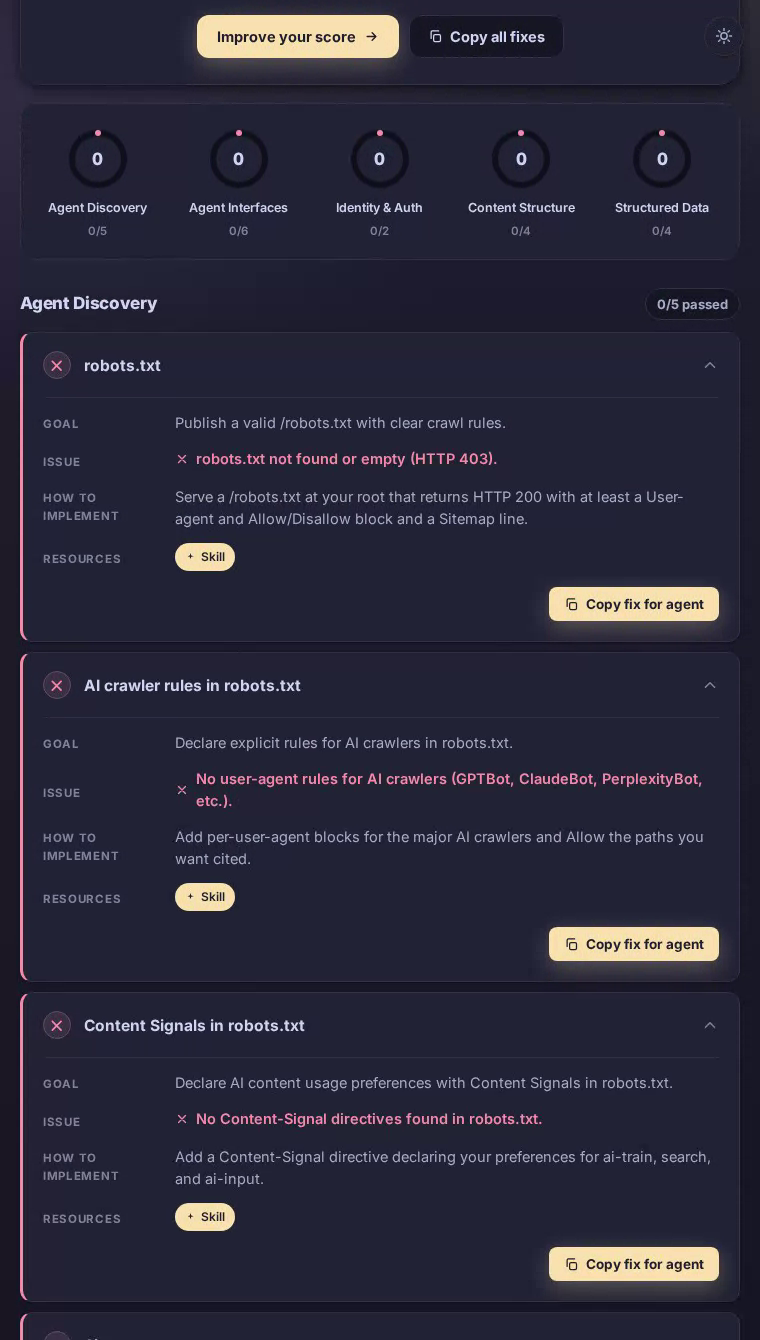
Add per-crawler User-agent blocks with Allow directives for menu pages, location pages, and any content worth surfacing in AI answers; apply Disallow to checkout and account paths. This single file edit governs how every major answer engine ingests the site.
Serve Markdown for agent requests
Return a Markdown version of page content when an AI agent signals it prefers plain text over HTML.
The site returns standard HTML even when a request carries Accept: text/markdown, giving agents a noisy document to parse.
Add server-side content negotiation: when the incoming Accept header includes text/markdown, respond with a clean Markdown document and set Content-Type: text/markdown. Browsers keep receiving normal HTML while agents get a structured, parseable version ideal for citation in AI-generated answers.
Publish an MCP Server Card
Let AI agents discover Portillo's capabilities through a standard machine-readable card at a well-known path.
No MCP Server Card was found at /.well-known/mcp/server-card.json.
Create and serve /.well-known/mcp/server-card.json containing serverInfo, a transport endpoint, and declared capabilities such as menu lookup or nearest-location search. This unlocks integration with MCP-compatible AI clients that can answer customer questions—like finding the nearest Portillo's or current seasonal items—dynamically rather than from stale training data.
Common questions
Why does Portillo's score 39/100 even though structured data rates 80?
What does an agent_discovery score of 60 mean for Portillo's?
How long would it take Portillo's to meaningfully raise its AEO score?
Is your own site ready for AI?
Run the same five-category analysis on any URL. Free, no account needed to start.
Check your own website free