How AI reads Stripe
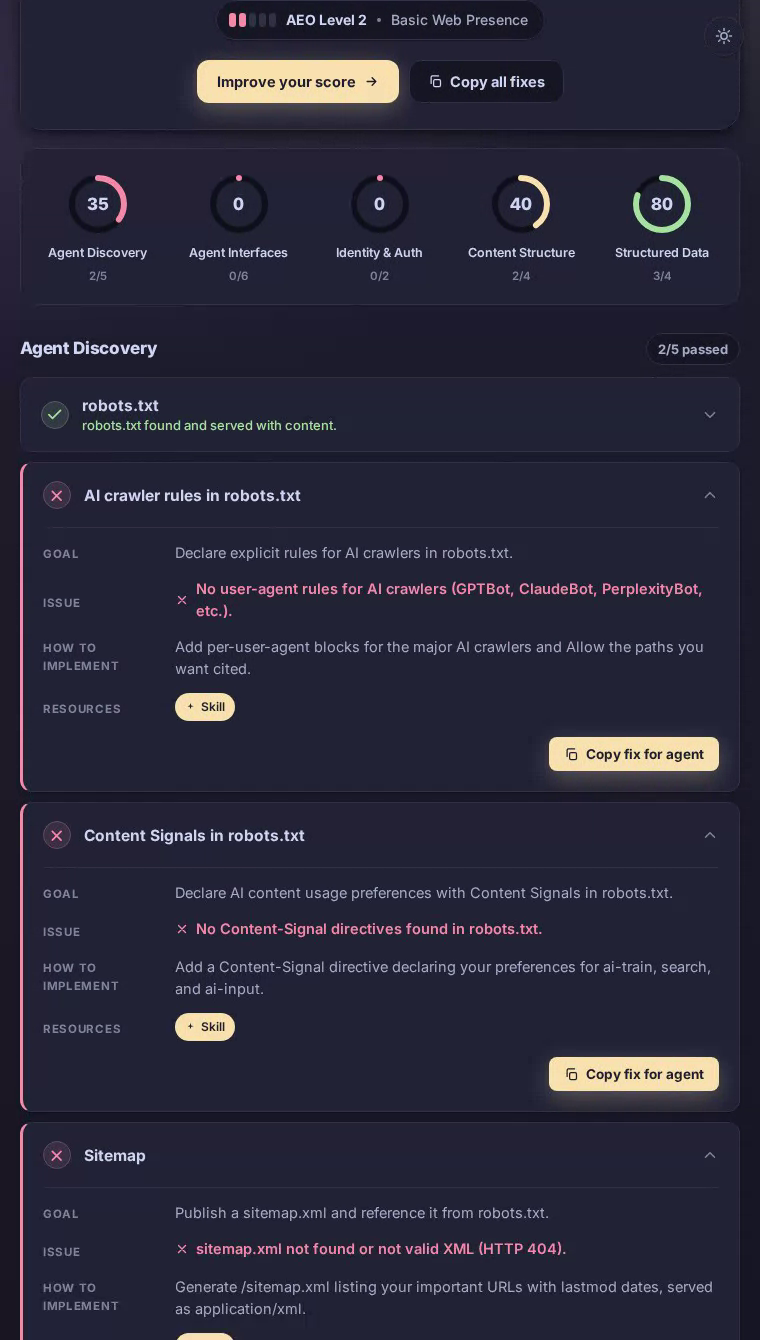
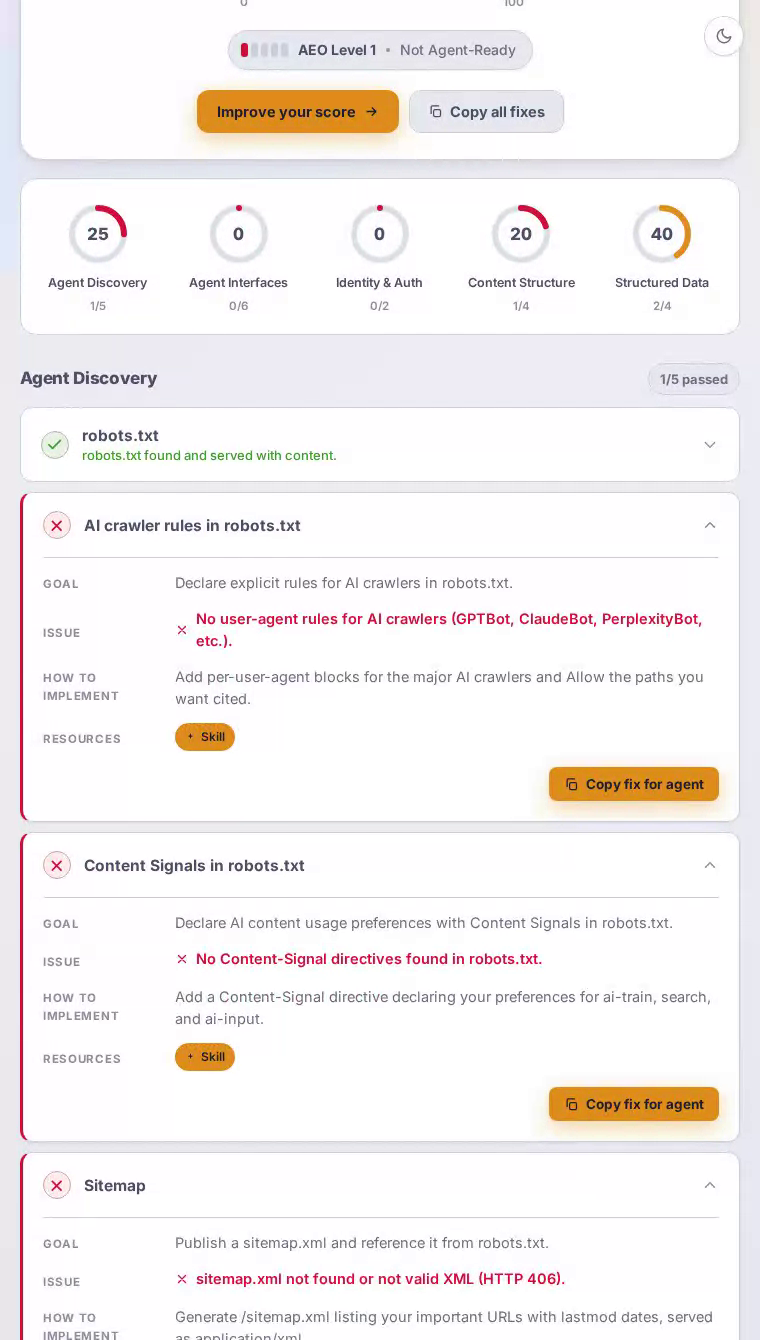
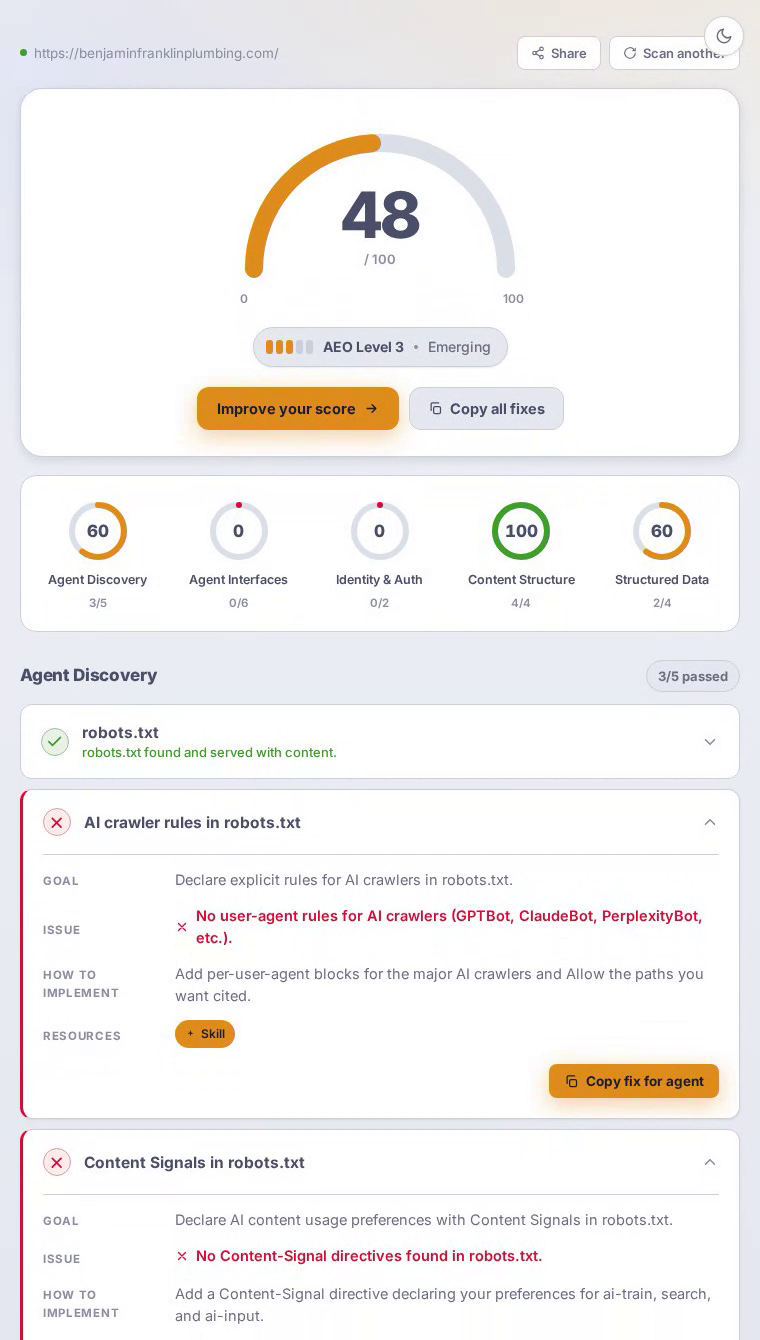
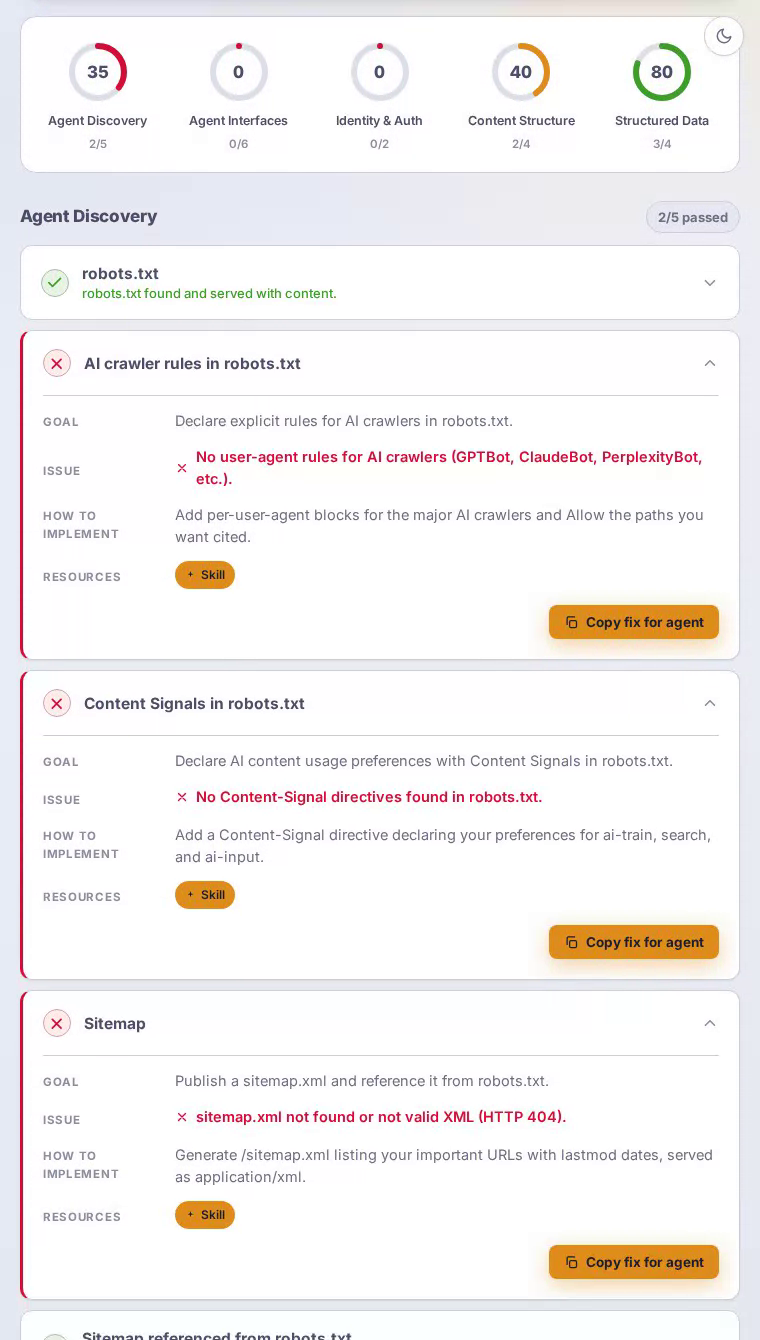
We scanned Stripe, the global payments infrastructure company trusted by millions of businesses worldwide, and measured an AEO score of 34 out of 100 — level 2. Structured data is the clear bright spot at 80, but agent interfaces and identity auth both sit at zero, meaning AI agents cannot discover or interact with Stripe programmatically.
What AI sees
When an AI agent visits Stripe's homepage today, it finds solid JSON-LD markup but almost no infrastructure built for agent-to-agent interaction.
Stripe's homepage delivers clean semantic HTML and strong structured data — the 80 score in that category reflects real investment in schema markup. An AI crawler can extract core business identity, product categories, and pricing tiers from the page. That is roughly where the good news ends. There is no sitemap.xml (the endpoint returns 404), so agents cannot enumerate the full content surface. The robots.txt file is silent on AI crawlers — GPTBot, ClaudeBot, and PerplexityBot receive no explicit guidance. No RFC 8288 Link headers point agents toward useful resources. For a company whose core product is an API, the absence of a discoverable API catalog is the most striking gap: agents querying about payment integration receive incomplete, surface-level answers.
Where it loses points
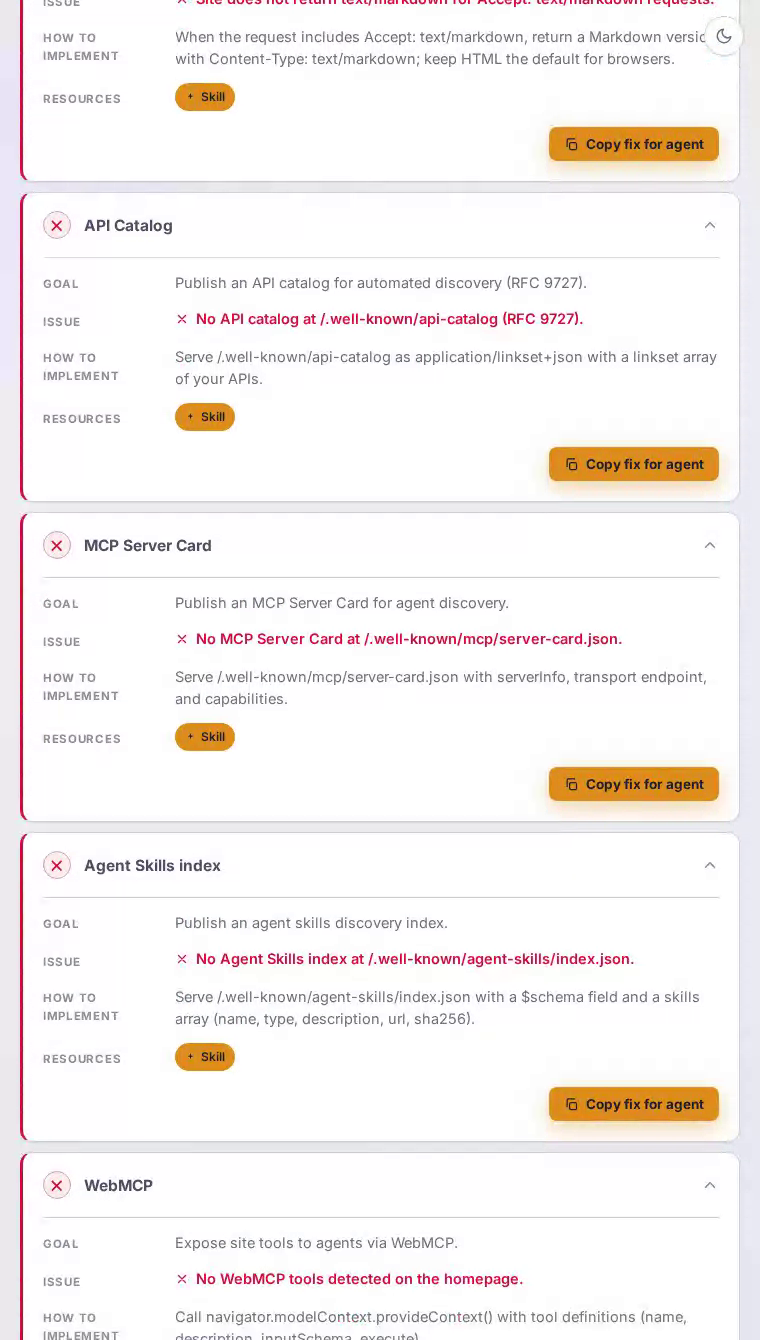
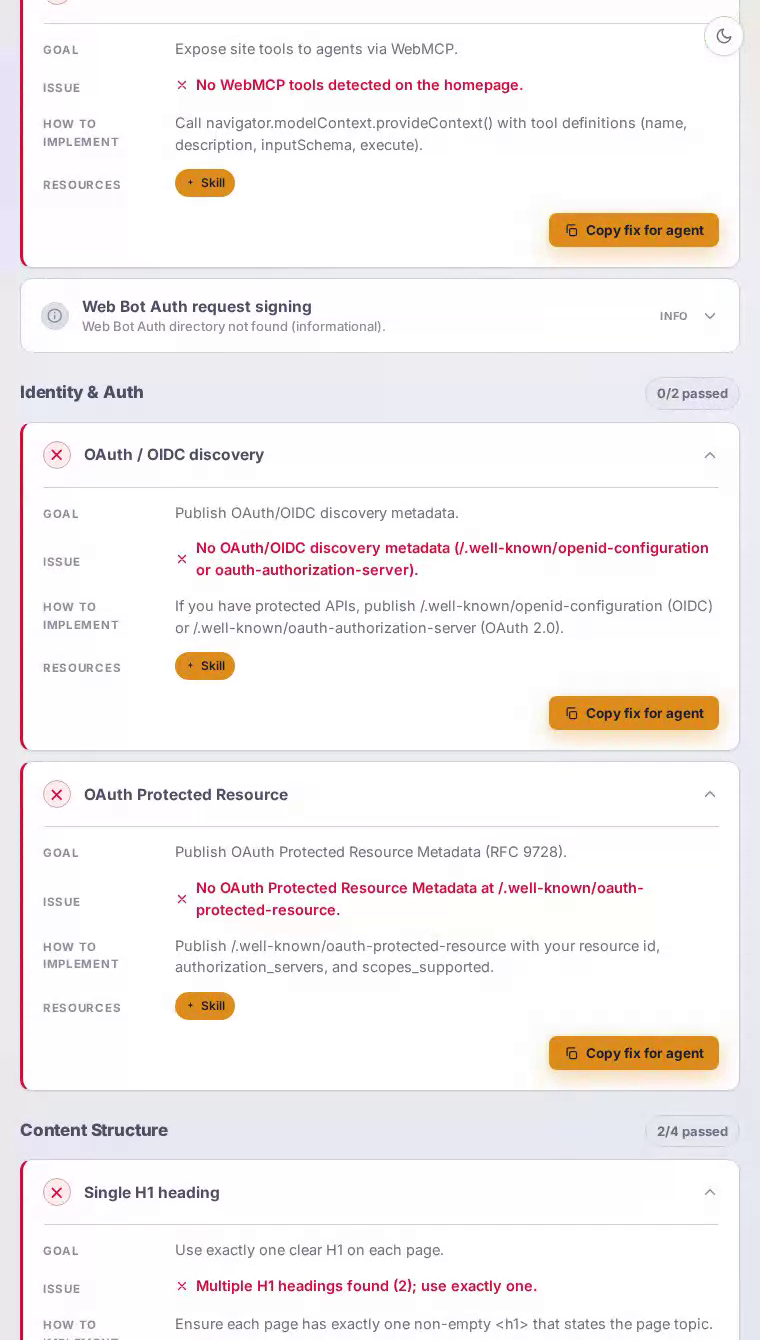
Agent interfaces and identity auth both score zero — Stripe publishes no MCP server card, no API catalog, and no agent skills index, leaving the agentic layer completely dark.
How to fix it
Three targeted additions would materially close Stripe's AI-readiness gap and position it as a first-class citizen in agentic commerce stacks.
Publish an MCP Server Card
Expose an MCP Server Card at the well-known path so AI agents can discover Stripe's capabilities and transport endpoint automatically.
No MCP server card exists at /.well-known/mcp/server-card.json, leaving agentic clients with no structured way to negotiate a connection.
Create a JSON file at /.well-known/mcp/server-card.json declaring serverInfo, transport type, and capability scopes such as payments.create and subscriptions.read. This single file unlocks Stripe as a first-party callable tool for any MCP-compatible AI agent or orchestration framework.
Add an RFC 9727 API Catalog
Publish a machine-readable catalog of Stripe's APIs so automated discovery tools and AI agents can find and understand every integration point.
No API catalog exists at /.well-known/api-catalog, which is especially damaging for a developer-first company whose entire value proposition is its API surface.
Serve /.well-known/api-catalog as application/linkset+json with a linkset array covering the core APIs — Payments, Billing, Connect, and Treasury at minimum — and include links to OpenAPI specifications so agents can resolve schemas automatically.
Declare AI crawler rules in robots.txt
Give AI crawlers explicit, per-user-agent directives so Stripe controls exactly which content trains models and which content feeds answer engines.
The current robots.txt contains no rules for GPTBot, ClaudeBot, PerplexityBot, or any other AI crawler, creating a policy vacuum that leaves citation and training behavior up to each crawler's defaults.
Add named user-agent stanzas for every major AI crawler with Allow directives for documentation and pricing pages Stripe wants cited. Append a Content-Signal directive declaring preferences for ai-train, search, and ai-input so aggregators respect the intent.
Common questions
Why does Stripe score only 34 out of 100 on AEO despite being one of the most developer-friendly platforms on the internet?
Does the missing sitemap.xml affect how AI answer engines respond to questions about Stripe's products and pricing?
How would publishing an MCP server card help Stripe in a world where AI agents execute financial workflows autonomously?
Is your own site ready for AI?
Run the same five-category analysis on any URL. Free, no account needed to start.
Check your own website free